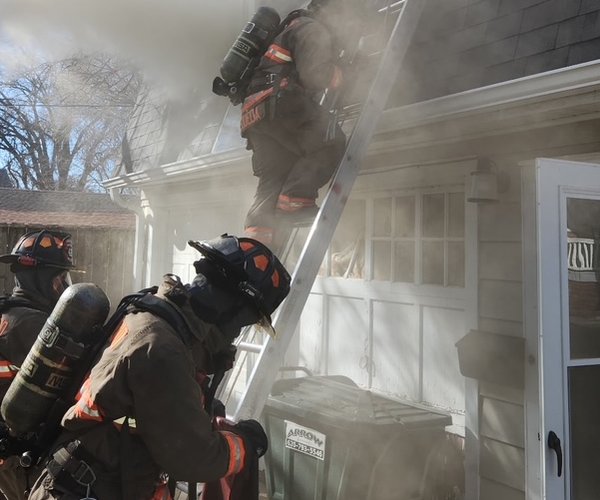
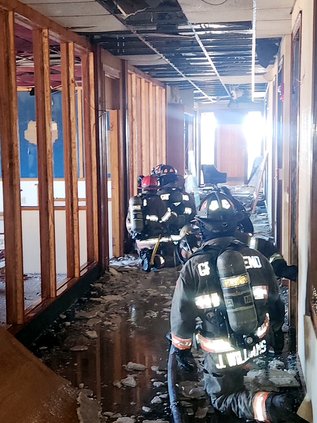
On Monday, Great Bend Fire Department crews mixed some training with the real thing while battling a residential fire in the community.
Last November, the Great Bend Recreation Commission noted that the clubhouse at Stoneridge Country Club would be razed and rebuilt, among other course improvements, as the “Friends of Great Bend” joined forces with the Rec toward a funding goal of $4 million to restore the course and make it public.
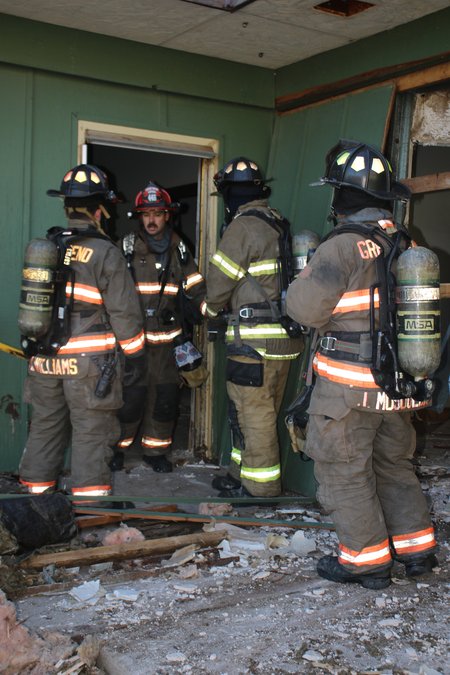
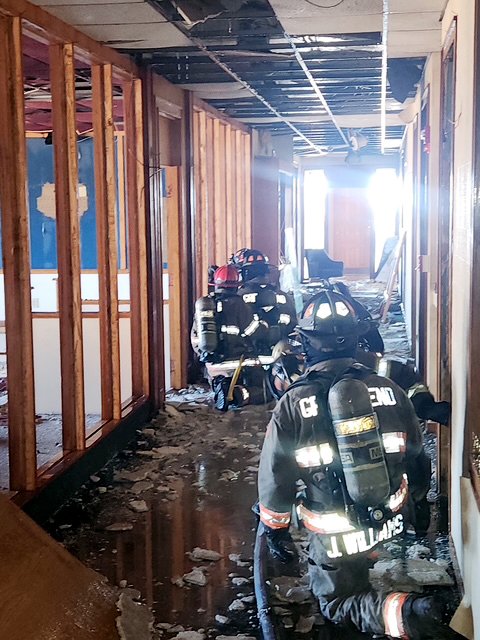
To that end, an “everything must go” auction on Feb. 28 emptied the building down to the bare walls. Meanwhile, the Great Bend Fire Department recognized an opportunity and scheduled a two-day training session for their three shifts to practice various fire attacks and entrance strategies on the building’s interior.
GBFD by the numbers
The Great Bend Fire Department is comprised of 28 shift members, overseen by the Fire Chief, Deputy Fire Chief, Fire Inspector, and Department Secretary. The force is divided into three shifts — A, B, and C — each with its own battalion chief, captain, and lieutenant, along with engineers and firefighters who each work 24-hour shifts. All personnel are highly trained in the most recent firefighting and EMS techniques. Covering the communities of Great Bend, Albert, and Pawnee Rock, as well as four townships, the GBFD serves 20,000 people, with an average response time of 3.5 minutes in the city and eight minutes in the county. The department currently has two staffed stations in the city and one unstaffed station at the Great Bend Municipal Airport.
Training day
On Monday, A Shift took training in the morning, while B Shift trained in the afternoon. Monday afternoon’s session was interrupted while a shift was on-site so that a pumper could be brought to the residence to assist with the reported blaze. On Tuesday, C Shift arrived at the clubhouse a little before 9 a.m. C Shift Battalion Chief Matthew Peterson’s crew found a clubhouse showing the effects of Monday’s training, but there were still plenty of doors to force open and walls to practice interior rescue and exit.
Beginning with the east wooden door, entry went smoother than expected for the two-man crew that was first to attack. The wooden Christchurch-paneled entrance was no match for the Halligan bar and the fireman’s axe that followed.
Forced entry explained
For firemen, forced entry is a critical, high-stakes skill that often determines the speed of rescue operations as well as the effectiveness of fire suppression. It’s essential for rapidly accessing secured buildings, saving trapped occupants, and creating entry points for hoses. A two-man crew typically works together to perform a forced entry, and efficiency usually outranks speed.
Essential forced entry tools include the “irons” — the Halligan bar and a flathead axe — used to “gap, set, and force” doors. Firefighters have been successfully utilizing the Halligan bar since 1948. It is named for New York City fireman Hugh Halligan, who allegedly modeled the bar after a burglar’s tool found in the rubble of a bank fire during overhaul operations. The Halligan has a two-fingered adze on one end and a pick on the other, each with specific functions in a forced entry situation. It has been recognized as the most versatile tool in the fireman’s arsenal over the past seven decades.
More entry practice
After opening the front door, the shift members moved to the back, where they were divided into two-man teams to take turns at the back door.
After the door exercise, the squad moved to interior operations, which included “swimming through the walls” — an exit strategy of breaking through a stud wall with a hole big enough to accommodate the fireman’s air tank on his back.
The clubhouse, still standing following the two-day exercise, now awaits demolition as the golf course renovation continues.