The Great Bend USD 428 Board of Education has approved free breakfast for students starting in January and continuing through May. The district will pick up the tab for one semester, an estimated cost of $20,000, and then see if it is something the board wishes to continue.
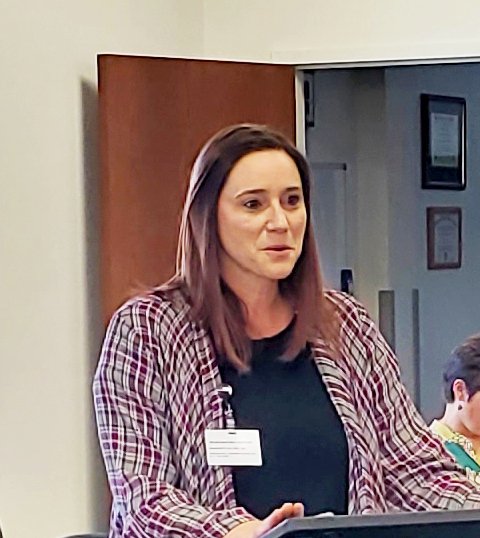
Food Service Director Kristy Alvord delivered this month’s Director’s Report at the Dec. 8 school board meeting, and mentioned the “universal free school meals” program as one option for providing free breakfast to all students. She previously shared this information when she gave the director’s report in October of 2024.
The district serves, on average, 1,900 lunches daily, and about 735 breakfasts, Alvord said. Lunch attendance is down a bit from last year, which may be due in part to modifications required by the federal government. Schools are gradually lowering the sodium and added sugars in their menus.
“We still have our sodium regulations that will be coming up in the 2027 school year,” she said. Great Bend is compliant for now, but by 2028 the guidelines will be stricter.
One thing that has boosted breakfast numbers is a “second-chance” grab-and-go breakfast, now available at the high school. They went from serving 30-50 breakfasts to as many as 250.
Free breakfast
Alvord showed what it would cost to provide free breakfasts, assuming participation will go up 10% or 20%.
She estimated the district can pay for breakfasts from January through May for $20,000.
“Unfortunately, we can’t use federal funds to pay for universal free breakfast, but I think it’s pretty important for these kids to come and have breakfast every day – with less sugar, of course,” she said. That’s why she was renewing her request for the program. “Food Service has some funds that they can use with our excess cash balance, but it’s only enough to last two or three months.”
Superintendent Khris Thexton said he and Alvord have discussed this and any cash balances Food Services has should be used for things like emergency equipment purchases.
Thexton said he’s looked for other districts that use the universal free foods program. Hays is the nearest. Although he said he will do more research, he said, “We thought this would be one good way to get kids started on the right foot, with a good breakfast – ready to go.”
Board member Sara Williams said that the district has a number of students who are eligible for free or reduced-price meals, “but I see a lot of families that are just right on the guideline for eligibility – where they’re just over. Those are the families I see that are struggling.” She said she’d favor helping them by offering the free breakfasts.
Thexton said it would be great if someone in the community decides to underwrite this program. “We have some very generous people in the community that donate for those that (need money for meals, etc.). We’re wondering if we have somebody in the community that would be interested in helping this program go as well.”
Board member Aaron Emerson made the motion, seconded by Williams, which passed 6-0. (Board member Chad Burroughs was absent.)
“Studies show kids that get a good breakfast do better in school,” Emerson said.
Williams commented on the lower sodium and sugar, and the hoops Food Service has to jump through.
“I think it’s an overstep in our government and I’m sorry you have to deal with it,” she said. “Kids aren’t eating what they don’t like.”
Federal guidelines and the Buy American Act
Alvord has acquired new software to separate added sugars and total sugars in menus, and they keep track of new guidelines for the Buy American Act.
In the past, she could buy pineapple and report this food is not produced in the U.S. “Now USDA has established a new rule that they will limit the percentage of total commercial food cost from non-domestic foods – that will phase over the next seven years. So starting this year, I have to track my non-domestic foods, and I cannot go over 10% of my food cost. Two years from now, it will be 8% and in another two years that will be 5%.”
U.S. food products are often more expensive than non-domestic, she said. Switching from non-domestic to domestic apple juice raised the price $4.83 per case (from $17.09 to $21.92) and Alvord said she buys about 60 cases a week. Domestic grape juice costs $6.51 a case more than non-domestic ($24.54 vs $18.03). She did see the price of orange juice go down when buying domestic (from $25.25 to $23.75, a savings of $1.50 per case), “which is a great thing.”
She is allowed to seek competitive bids and purchase less expensive non-domestic foods so long as she stays within the 10% leeway.
Alvord also said USD 428 will soon be featured in the Kansas State Research and Extension newsletter for its use of local foods. (See related story.)
Contributions and grants approved
Contributions and grant applications were approved at Monday’s meeting.
Several teachers applied for and will receive Credit Union of America Fall 2025 TGIF Grants:
• Amy Stein, Great Bend Middle School, $500 to purchase digital media literacy supplies.
• Robyn Heitschmidt, GBMS, $940 to purchase 5 Dino-Lite USB digital microscopes to view rocks and minerals.
• Hillary Emerson, Little Panthers Preschool, $1,000 to purchase various seating alternatives that help with sensory needs at the Pre-K level.
Park Elementary received $50 from the Park Booster Club for front door artwork and $80 from the booster club for Veterans Day lunches for veterans.
Park, Eisenhower, and Riley Elementary schools each received a $500 contribution from Wheatland Electric.
The Gifting Forward Foundation contributed $250 to Lincoln Elementary School to celebrate the school’s contributions to the Power the Pantry food drive.
GBMS Music in Motion received a $500 performance contribution from Hays (High Plains) Kansas.
The Great Bend High School Activities Department received the following contributions:
• Bauer, Pike, Baer, Wary, Carroll, & Gunn LLC contributed $350 for Halloween Activities.
• Panther Booster Club contributed $7,220 towards the Golf Simulator project
• Panther Booster Club contributed $4,668 for GBHS students’ entry to get into the post-season games.
• Marmie Motors Auto Group contributed $2,400 for touchdown incentives.
• Ohiopyle Prints contributed $61.33 for apparel reward incentives.
• BSN Sports contributed $25.63 for apparel reward incentives.
New teacher hired
The board approved one new hire, Ekaterina (Kate) Semeniuk, who will join USD 428 on Jan. 5, 2026, to teach fourth grade at Eisenhower Elementary School. She is a new teacher who graduated from Bella Vista Prep and earned her Bachelor of Science degree from Barclay College in May of 2025. She did her student teaching at USD 438 Skyline.