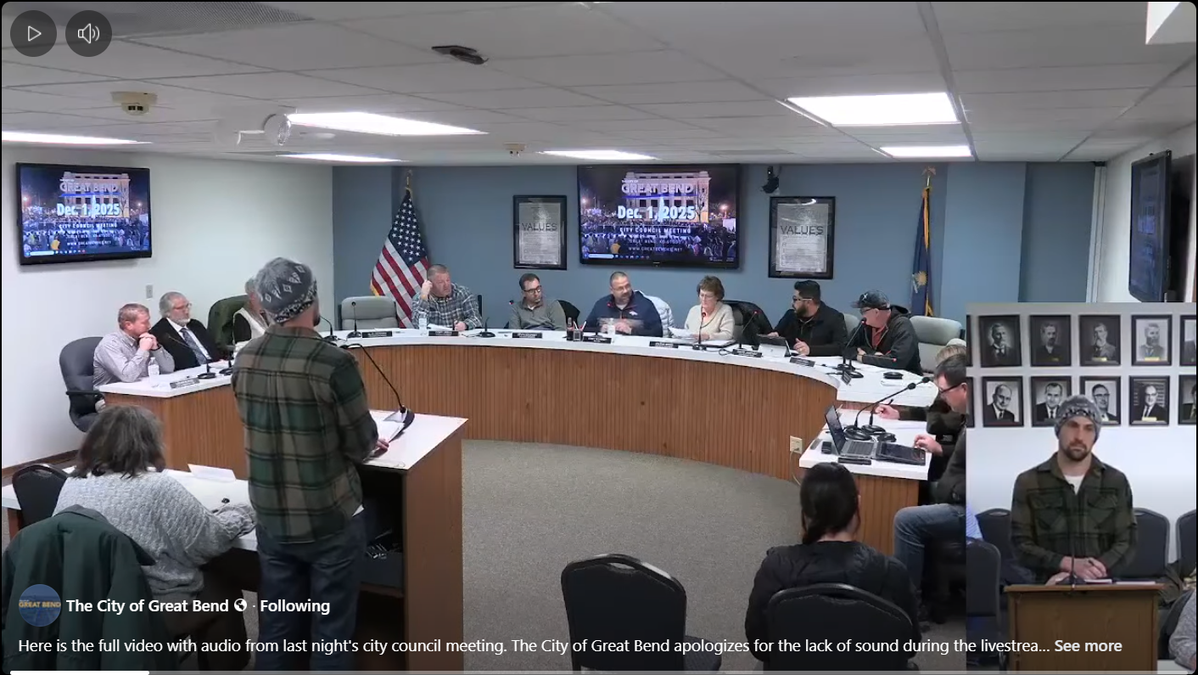
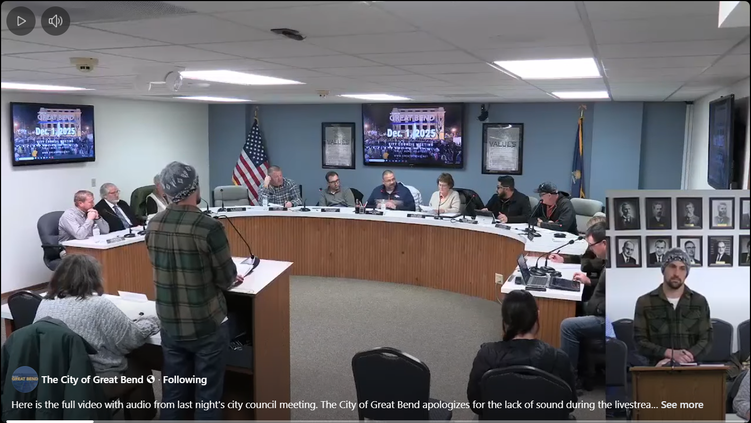
At the Dec. 1 Great Bend City Council meeting, Mayor Cody Schmidt stopped Andrew Murphy, reporter for the Great Bend Tribune, from asking questions about the role the City has played in Great Bend Economic Development Inc (GBED). Mayor Schmidt explained that the policy of City Council meetings does not allow topics on the agenda for consideration by the Council to be discussed during the open forum. The policy states, “The public is free to comment on items not listed on the agenda,” and that visitors should limit comments to three minutes.
Last Wednesday, the Tribune met with representatives to discuss the policy as well as the role the City has in GBED. Present at the meeting representing the City was Mayor Schmidt; Council Members Jolene Biggs, Alan Moeder, Kevyn Soupiset; City Administrator Logan Burns; Public Relations Director Addison Crites; and City Attorney Allen Glendenning. Andrew Murphy, reporter, and Dee Duryee, general manager were there on behalf of the Tribune.
GBED and City
City Attorney Allen Glendenning explained the reasoning behind why GBED was created. The organization was created as a partnership between the City of Great Bend and the Great Bend Chamber of Commerce with the sole focus of improving economic development for the city, he said. GBED is incorporated as a not-for-profit membership corporation – having no shareholders, only two members of the corporation: The City and the Chamber. The separate entity is responsible for administrative duties and employment decisions rather than being under the control of the City or having employees within the city managing the duties of economic development.
A separate nonprofit entity also allows for private donations to those that would not normally donate directly to the city and also helps add a layer of confidentiality relating to businesses that may want to relocate to the area.
“Sometimes you can’t get people (businesses) to come to town and talk to you if they’re not confident that they can have initial conversations without it being let out,” Glendenning said.
Before the creation of GBED, the City contracted with the Chamber and economic development was under their umbrella until 2019 when the decision was made to move away from that agreement.
“It was in the best interest of the City to move away from there and do something different,” councilmember Biggs said.
When asked why the role of economic development still seems to be the same, just under a new entity, Glendenning noted that it is now a partnership between the City and Chamber rather than just controlled by the Chamber. “Initially, the city had more control over it (GBED) than it does now.”
Originally, when incorporated in October 2019, the City selected two of the five directors, with priority given to city council members, to sit on the Board of Directors (BOD) for GBED. The Chamber also selected two directors with the fifth director being an at-large position selected by the other four directors. The Bylaws (the organization’s governing document) were changed in October 2021 to increase the number on the Board of Directors to seven and a Selection Committee was established to appoint the directors. The five-person selection committee was comprised of one person appointed by the City Council, one person appointed by the Barton County Commissioners, one person appointed by the Chamber of Commerce, and the remaining two selectors being the BOD Chairperson and Vice Chairperson.
GBED no longer has any elected officials sitting on it or its related organizations’ Boards of Directors (Advancing Barton County Children, Great Bend Alive, Great Bend Holdings). The County previously had a Commissioner as a GBED director, as well as a selection committee seat, until Commissioner Shawn Hutchinson resigned in Dec. 2024.
In late 2024 a resolution was passed by GBED’s BOD to remove the County appointed selection committee member. The City then gained that committee seat, increasing the City representation on the committee to two. It was also resolved that in order to avoid potential conflicts of interest, elected officials shall be ineligible to serve on as Directors.
With no elected officials directly sitting on the BOD the question was asked: Isn’t this situation basically the same as it was before GBED was created – A separate entity contracted by the City to help with economic development?
City representatives at Wednesday’s meeting don’t think the situation is the same. The Chamber had multiple roles, with economic development being just one of its duties, and now GBED is made up of elected directors coming together solely focused on economic development with the City having only some say in picking those members, they said. The City “picks a committee that picks a board,” Glendenning said.
The City does have control if they continue to fund the organization and Biggs said. “If we feel like they’re not doing their job, then the Council can determine that we don’t fund it,”
Mayor Schmidt added, “On a year by year basis they have to prove themselves to get the City funding.”
How are the City funds spent?
“It’s mostly spent for salaries and machines and infrastructure.” Glendenning said. “The real work, the funding that does the work, is the grants they go out and get,” and GBED has received several million dollars in grant funding since its inception.
The question was also asked why the City has not received documents and records that are required to be provided from GBED to the members of the Corporation of which the City is one member of two.
According to the bylaws, the Corporation shall provide quarterly reports to the Members of GBED’s property and business transactions, including assets, liabilities, receipts, and disbursements. Requests for documents under the Kansas Open Records Act (KORA), revealed that the City has never received these documents.
“The quarterly reports were not done,” Glendenning said, “I think that’s an oversight that is being corrected with the new Director (GBED) and the new City administrator (Burns), that’s been brought to our attention, and we thank you for bringing that to our attention, but that is something that needed to be fixed, and is being fixed.” Glendenning also noted that the basic information was provided on an annual basis and the previous GBED Director Sara Arnberger gave monthly updates to the City Council.
The City does have the right to inspect the books and records, including the BOD meeting minutes, Glendenning said. But even though the registered office of GBED is 1209 Williams, which is the City Hall building, and bylaws state documents will be held at that address, he does not think it violates any laws that the documents are stored at GBED’s office at 3111 10th St. He also said the question of whether GBED is governed by the Kansas Open Meeting Act or KORA is an interesting legal question.
Council Meeting Public Comment
The public forum portion of City Council meetings, presented during the Visitor and Announcement item on the agenda does state no comments are allowed related to topics under consideration of agenda items.
Glendenning provided an explanation on why the policy exists.
“There’s no requirement that there be any public comment at all, at City Council meetings. They’re not town hall meetings. They’re City Council meetings. All that’s required by law is that you be allowed to listen and attend.”
“We have our city council meetings by elected representatives, and their deliberations are to be done by them, and the public is not entitled to participate in that. They (public) are entitled to listen to it and observe it. That’s what the Open Meetings Act requires.”
The agenda is provided the Wednesday in advance of the Monday meetings, he said, and if people want to talk to their council members about an issue, they can write letters, they can talk to them or they can call them and that can be dealt with that way, rather than having people show up and try to turn a City Council meeting into a town hall meeting.
Some topics require public hearing and the public is allowed to speak during those public hearings but regular agenda items are not the same as a public hearing.
It was also explained that the public comment session is also just that, where the public can comment and it is not meant to be a back and forth conversation between the public and elected officials.
“The public comment section is meant to be one way.” Glendenning said. “The public can come up and give information to the body as a whole. It’s not supposed to be addressed to one particular individual, and it’s not an opportunity to ask questions. It’s just an opportunity to say, ‘I got something on my mind that I want to tell you guys.’ So if you’re thinking you come to one of those to ask questions, that’s not going to work either, and that’s kind of a general rule everywhere. It’s not a press conference.”
Mayor Schmidt did apologize to Murphy and said he could have explained the policy and procedure better.
Murphy’s address to the Mayor and Council at the Monday, Dec. 15 City Council Meeting will be published in Thursday’s issue.