On warm nights when my bedroom window was open I could hear the endless stream of vehicles on Route 66. We lived in a small house at the east edge of Baxter Springs and across the street from my window was a pasture and on nights when there wasn’t any wind the sound of escape — the rushing of tires, the shifting of gears, the bellowing exhaust of trucks hauling goods to Oklahoma or Missouri — swept across the field with the night breeze.
During the summer I would spend those nights reading, John Steinbeck and Harper Lee and the Saturday Evening Post and stacks of comic books, all to the sound of the highway, until the sun crowned the trees at the far end of the pasture. That was when I was reminded of how small my world actually was, a city of a few thousand clustered around the most iconic road in America.
It seemed as if I were trapped on an island in the stream of commerce, adventure and danger that was Route 66. I was filled with anxiety. I both longed for and feared the day that I too would be swept along to an unknown shore in the unfolding of time. Interstate 44 had bypassed the town years before, leaving Baxter a backwater, but if you were bound for where the sun rises, or where it sets, the only way out of town was 66.
This year is the centennial of Route 66 and I’ve been thinking of the highway, which already seemed ancient when I was growing up, and how it shaped me. Described as “an agent of social transformation” by the National Park Service, the 2,400-mile long route began in Chicago and ended at the Santa Monica Pier. The highway crosses just 13 miles of Kansas, cutting across the extreme southeastern corner of the state on its way from Missouri to Oklahoma. Just three Kansas towns were on the route: Galena, Riverton and Baxter Springs.
The Kansas section of Route 66 is less than 1% of its total length, but to my childhood self it represented the whole world. By the time I was in junior high I had walked or biked most of it with my friends, especially the sections like the Marsh Rainbow Arch Bridge over Brush Creek that had been orphaned by highway improvements. My father had briefly owned a service station on Route 66 in Baxter and I remember driving him crazy by jumping up and down on the air hose that made the bell ring inside the station. Later, when I learned to drive, I was racing cars on a quarter-mile section of the old concrete Route 66 just outside town.
There wasn’t a spot along the route that didn’t figure in our family history. My grandfathers had been at the zinc mining riots of 1935, with violence dotting 66 from Galena to the Oklahoma line. Three decades later my father picked up a hitchhiker east of Baxter Springs and was carjacked at gunpoint for his trouble. The main street, Military Avenue, was 66 and my mother drove it in an old blue early-60s Thunderbird (think “Thelma and Louise”) before the cars were considered cool again.
If you’ve heard 66 called the Mother Road, it’s because that’s what John Steinbeck called it in “The Grapes of Wrath.”
The novel came out in 1939.
“66 is the path of a people in flight,” Steinbeck writes, “refugees from dust and shrinking land, from the thunder, of tractors and shrinking ownership, from the desert’s slow northward invasion, from the twisting winds that howl up out of Texas, from the floods that bring no richness to the land and steal what little richness is there. From all of these the people are in flight, and they come into 66 from the tributary side roads, from the wagon tracks and the rutted country roads. 66 is the mother road, the road of flight.”
Larry McMurtry, author of “The Last Picture Show” and “Lonesome Dove,” noted in 2000 that the romance of the American road was often at odds with the reality of travel in the middle of the last century.
There will be countless celebrations this year across the remnants of Route 66, in places like Winslow, Arizona, and Shamrock, Texas. Route 66 was an icon even while I was growing up, thanks to a catchy song by Bobby Troup and a 1960s television adventure drama starring Martin Milner and George Maharis and a Corvette Stingray. In 2006, Pixar gave us an animated version of the highway in “Cars.” Books about Route 66 are almost their own sub-genre of nostalgia travel, with the best coming from Michael Wallis in 1990.
In the beginning, Route 66 wasn’t so much a construction project as it was an idea to link existing roads together to form a diagonal path from Chicago to St. Louis to Los Angeles. The highway was established Nov. 11, 1926, by the U.S. Bureau of Public Roads. In southeast Kansas, the roads to be incorporated were partly concrete and partly dirt, but the now-famous Rainbow Arch Bridge was already in place, having been built in 1923.
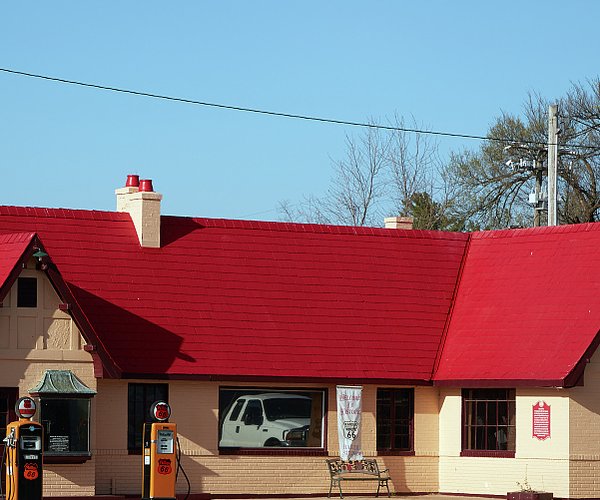
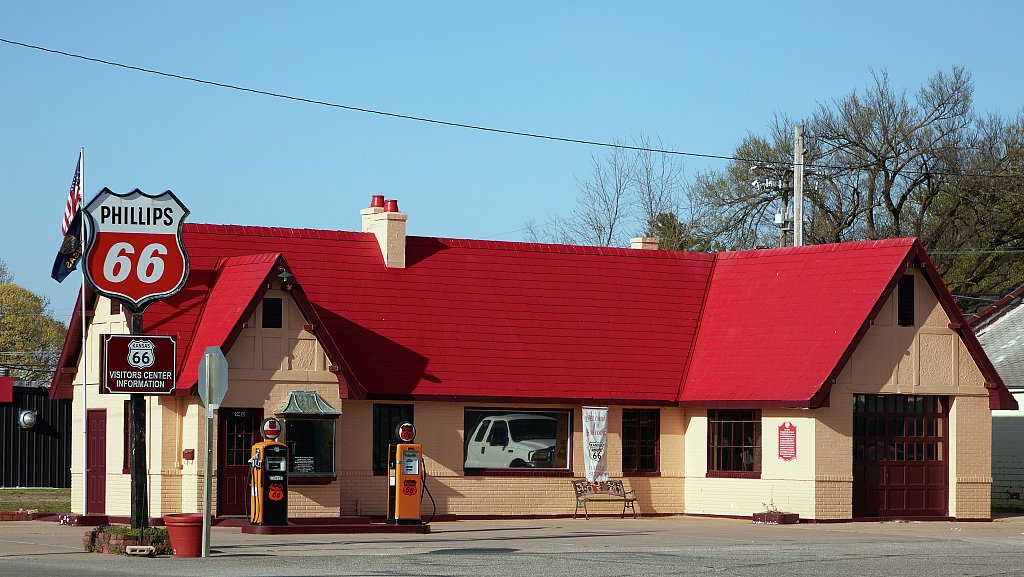
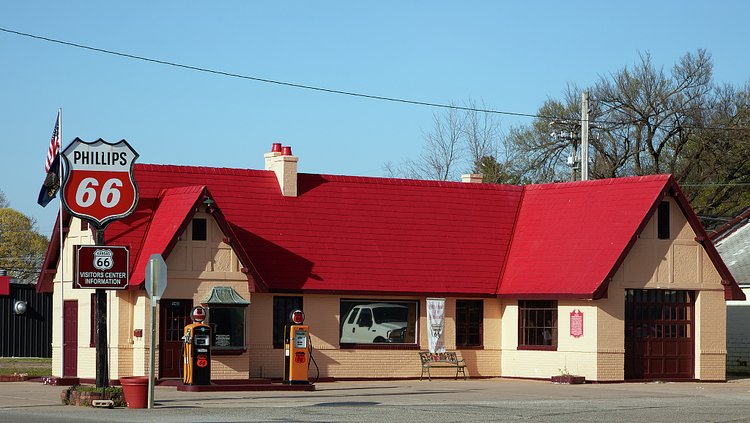
The bridge is among the Route 66 remnants preserved in Kansas. The visitor’s center in Baxter is a 1930 cottage style Independent Oil and Gas service station at the north end of the business district.
In the spring of 1935, the Union of Mine, Mill and Smelter Workers went on strike to protest working conditions at Galena. Violence flared in June, when hundreds of strikers gathered near the Eagle-Picher Smelter, overturned automobiles, and blocked traffic on Route 66. The strike, which encompassed the entire mining region of Cherokee County, was quelled by the Kansas National Guard, but sporadic violence continued for years, including the dynamiting of the natural gas lines feeding the smelter.
Despite the area’s rough history, the National Park Service manages to find beauty in some of the Route 66 remnants of the east Galena district.
“One mile west of the state line is the crown jewel of the national register district,” according to the National Parks Service, “the Route 66 viaduct. A graceful structure measuring 215.9 feet in length, it curves gently as it carries the two-lane road across the tracks of the Missouri, Kansas and Texas Railroad.”
At the west end of Galena, you can find more tourist-friendly attractions, including Luigi’s Pit Stop, a roadside attraction inspired by the “Cars” movie. It is one of several locations in Kansas that will hold Route 66 Centennial events, beginning April 4. ...
As years passed Route 66 became not a road of flight but just another lonely highway. I’ve traveled it for research, conferences and sometimes pleasure, but seldom to revisit the past. Meanwhile, the route has turned into a nostalgia machine, and now there is hardly a remnant left that hasn’t been the focus of historic preservation and, in the words of grant writers, commercial “revitalization.” Good for the communities that benefit. ...
Beneath the neon Route 66 is real America. It represented in dirt and concrete and asphalt the aspirations of generations, and when the last bit of it was decommissioned in 1984, the American dream changed with it. ...
Dreams wouldn’t be worth having if they didn’t involve struggle. I remain anxious, about nuclear oblivion and class differences and a hundred other matters. But at least now I know where home is.
Max McCoy is an award-winning author and journalist. A Kansan, he started his career at the Pittsburg Morning Sun and was soon writing for national magazines. His investigative stories on unsolved murders, serial killers and hate groups earned him first-place awards from the Associated Press Managing Editors and other organizations. This column was edited for length. Read the full article online at KansasReflector.com/comentary /.