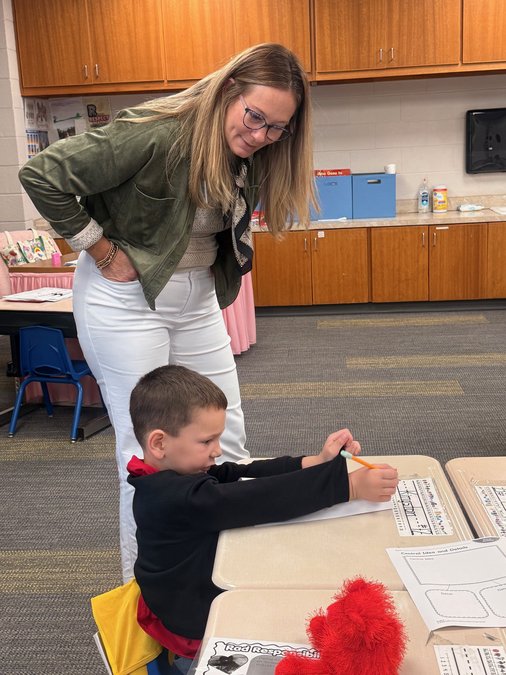
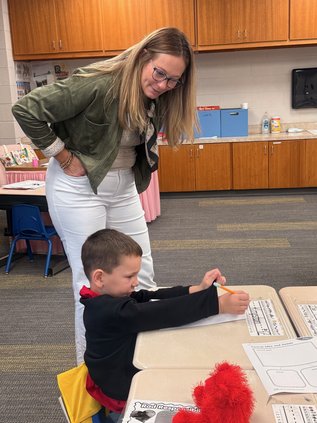
At Lincoln Elementary School, leadership isn’t defined by age, title or position. Principal Dr. Misty Straub believes anybody can lead from anywhere, and she’s empowering students to prove it by taking ownership of their classrooms, supporting their peers and discovering that even the youngest voices can make a difference.
“We have focused so much the last few years on transferring some of what we do to the students,” she said. “Our students are learning to step up and lead, and not necessarily wait on adults to do that for them.”
Lincoln uses student ambassadors to greet classmates and visitors in the morning, assist with special events and take on leadership roles in their classrooms.
“We give everyone an opportunity to be an ambassador,” Straub said. “Each classroom is a little different on how they choose them, sometimes they nominate them and sometimes they just use a rotating order. But everyone gets a chance to lead.”
Sometimes, those young leaders can reach their peers in ways adults cannot.
“When a student is having a tough moment, sometimes we go get a student ambassador who is able to turn them around much quicker than an adult can,” she said.
The goal, Straub said, is to empower students to take responsibility for themselves and their classrooms, carrying their core values with them throughout the school day.
“They can take their core values with them from class to class and we teach them to use those to hold the class accountable,” she said.
That philosophy requires teachers and staff to step back, relinquish some of their traditional responsibilities and trust students to take the lead.
“We want kids to leave here being able. If we don’t allow them those opportunities to lead, they’re not able — they rely on us as adults to do a lot for them,” Straub said. “We’re just doing them a disservice by doing that.”
For Straub, helping students discover their potential is especially meaningful because she once walked the same hallways.
A Great Bend native and former Lincoln Elementary student, Straub didn’t initially envision a career in education.
“My career pathway was in the medical profession. I wasn’t quite sure in what way but physical therapy really drew me,” she said. “I took some general education courses at Barton and it quickly steered me toward education.”
After befriending education majors and hearing about their coursework, she began reconsidering her future.
“It really enticed me,” she said. “It wasn’t something I dreamed about but I’m glad it happened the way it did.”
Straub attended Emporia State University, where she earned her bachelor’s and master’s degrees in education. After a positive student teaching experience, she accepted a teaching position in Emporia.
She taught second and third grades for nine years before spending three years as an instructional coach.
Although she enjoyed working in Emporia, she and her husband, Mark, always hoped to return to their hometown.
“I loved the schools but my husband and I are both from here and our families are here so we always wanted to come back,” she said.
Mark works at KanEquip. The couple’s oldest daughter is a nail technician and recently made them grandparents. Their youngest daughter is studying nursing at Wichita State University.
“One of the many things that really enticed us about our community is it really has kind of a hometown feel — it really draws you in,” Straub said.
While working in Emporia, Straub also discovered an interest in educational leadership, thanks in part to an administrator who recognized her potential.
“While in Emporia, I had an administrator who pushed me into bettering myself and being an administrator,” she said. “She told me she saw leadership in me and I really appreciated that. It kind of drew me toward that pathway.”
She later earned her doctorate in educational leadership and management from Baker University.
Now in her 15th year as Lincoln’s principal, Straub said the instructional side of administration remains her passion.
“I’m an instructional leader and what drives me in this career is working with curriculum, assessment, learning and professional development,” she said. “But the other part of this position, which is the management side, is not what drew me to it and there’s so much of it during your day.”
One misconception she encounters is that a principal’s primary responsibility is disciplining students. In reality, she said, much of her day is spent building relationships.
“Honestly, I think 80% of my interactions with students are just more on the day-to-day things, just general interactions where I’m checking on their well-being,” she said. “Really, most of the day isn’t disciplining kids, it’s just connecting with them.”
Those connections extend to Lincoln’s 35 staff members, whom Straub describes as driven and committed to finding solutions.
“They are so good about identifying where there’s a need — good or bad — and problem-solving and working together to solve things,” she said.
Like other schools, Lincoln has faced changing family dynamics and new challenges in reaching students and parents.
“It’s not bad, just different,” Straub said. “Sometimes communication can be different in different family structures and learning how to best reach families has been interesting. It’s been a challenge but not one that we can’t overcome.”
She also worries about the demands placed on children outside the classroom.
“We are involved in so many things outside of school — it becomes almost a requirement,” she said. “Kids just don’t have a moment to just go be a kid.”
Technology adds another challenge. Although Straub recognizes its benefits, she believes children sometimes struggle to balance their digital lives with simply being children.
“It’s hard to balance those digital things with just being a kid,” she said.
While the environment children are growing up in has changed dramatically over the decades, Straub believes their fundamental needs remain the same.
“They’re assimilating to their environment the same way our kids did 20 years ago and 50 years ago,” she said. “I think sometimes judgment calls are made about kids in our community and people don’t know their background.”
She also recognizes the toll that criticism of public education can take on teachers, particularly when broader concerns are directed at educators.
“We have to talk to each other about stepping back and saying this is a global issue, it’s not a you issue,” she said. “We ask ourselves how can we impact that here and sometimes just understanding that we can’t impact everything and acknowledging that is hard.”
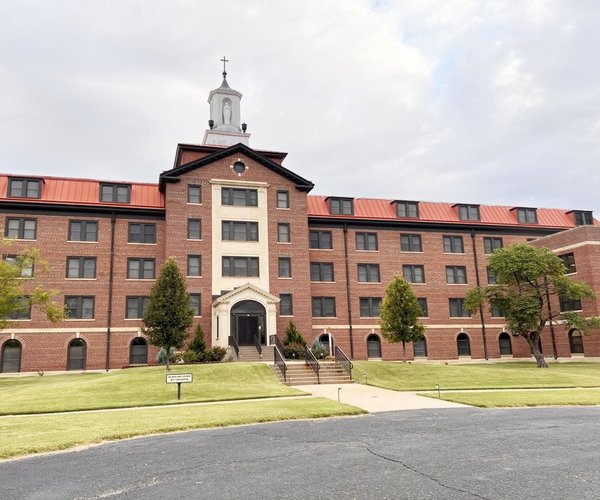
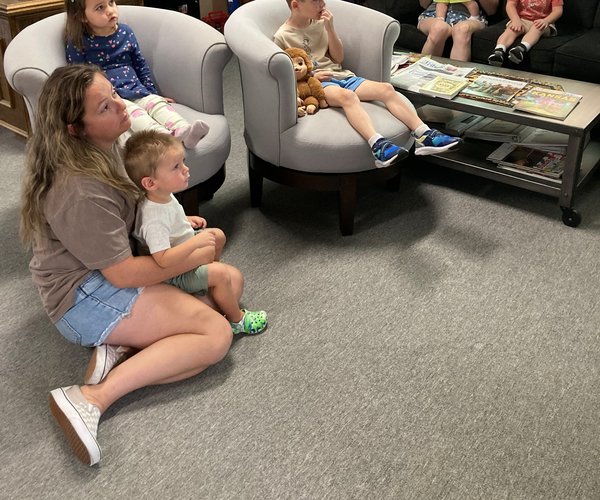
For its 250 students, Lincoln is more than a place to learn. Straub considers it a neighborhood school where children build friendships and find a sense of belonging.
“Students grow up together and do things together so they all combine very well, a lot of the times through family as well,” she said. “There isn’t a park close that’s safe to get to so for a lot of kids, this is their safe place to play after school, as well.”
That sense of community is complemented by a commitment to identifying and addressing students’ individual academic and social needs.
Lincoln uses a multitiered system of support that combines formal assessments with daily observations to monitor student progress.
“We do benchmarking but also informal things throughout the day, maybe just observing how they solve problems in math, or listening to them read or watching them respond to peers,” Straub said. “So we’re constantly taking notes on how kids are doing.”
Staff members regularly review the information to determine whether adjustments are needed for individual students, small groups or entire classrooms.
Those adjustments may include changes to WIN time, which stands for What I Need, a period designed to provide students with additional support based on their individual needs.
But Straub emphasized that teachers and staff cannot do it alone. Parents play an essential role in helping students succeed.
“Just having parents who stay up to date with what’s going on, show interest in what they’re learning, stay present and support teachers when hard conversations have to be had — we just absolutely love it,” she said. “We love those that check in, ask questions and communicate with the teachers.”
Those difficult conversations can sometimes be challenging for families, particularly when teachers must address concerns about a student’s progress or behavior.
“Sometimes teachers can be misrepresented when we have to have open and honest conversations,” Straub said. “It’s very personal for a parent, understandably, so sometimes it’s hard to get that support to better the student.”
Despite the challenges that come with leading a school, Straub said the most rewarding part of her job remains the students themselves.
“I have several that won’t leave without giving me a hug, or if I pass them in the hallway, I get a hug or a fist bump,” she said. “I love it when you ask them how they’re doing and they ask it back. It just makes my day.”
And while she hopes Lincoln’s students leave with the confidence and independence to lead wherever life takes them, she also hopes they carry something less tangible.
“Years from now, I hope our students remember the connections they made, whether that be with students or adults,” Straub said. “I just hope they feel connected. It’s when someone doesn’t have a connection that you worry.”