Sandra Geschwentner was just 18 when she enlisted in the Army National Guard, hoping to earn money for college. She never imagined that decision would take her halfway around the world to Saudi Arabia during Operation Desert Storm or that, decades later, she would still be dealing with the physical and emotional challenges that followed.
Today, as a veteran, wife, mother and cancer survivor, Geschwentner wishes more people understood the sacrifices made by those who serve — and the families who stand behind them.
She wishes people understood that someone paid the ultimate price for the freedoms they enjoy. That those freedoms should never be taken for granted.
And she wishes people would stop acting as though they are entitled to them.
For Geschwentner, those feelings come from personal experience.
“I was very excited about it,” she said. “I do remember that it was a little overwhelming at first. I called my mom and said, What did I do?”
Geschwentner completed basic training in Fort Jackson, S.C., where she stayed in old World War II-era barracks. She was among the last soldiers to train in those facilities.
After returning to Kansas, she served with the Hays unit of the Army National Guard. Then came the call that would change everything.
“My family was initially okay with my decision to enlist because it was the guard,” she said. “When I had to go to Desert Storm and it was a war situation, it was a little different for my family – especially my parents.”
But Geschwentner knew being in the National Guard did not exclude you from an active military situation.
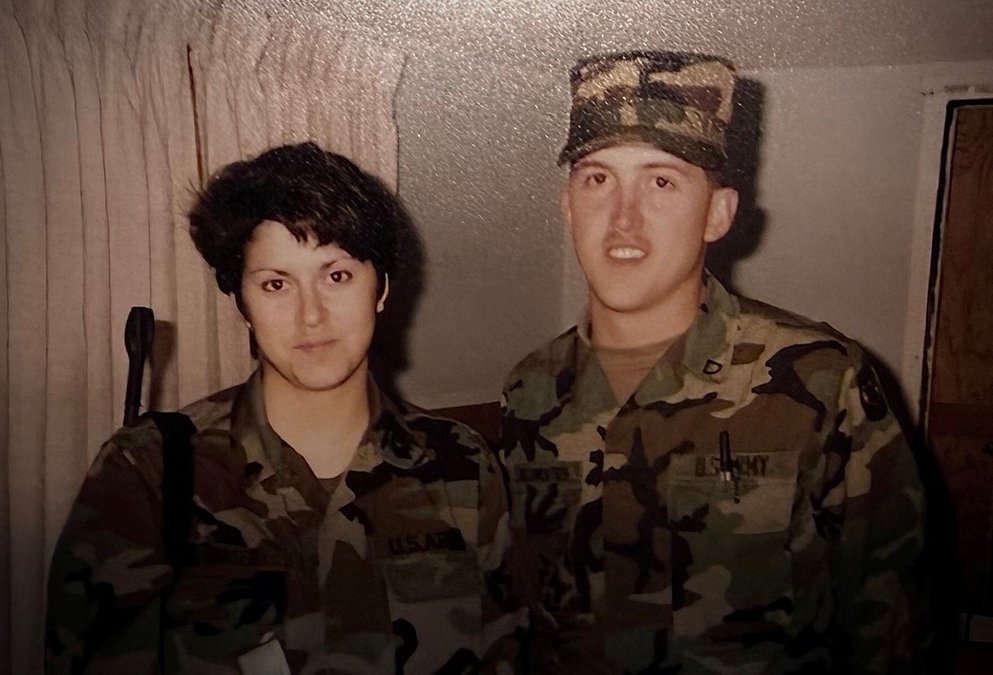
The unit left for Fort Riley right after Thanksgiving 1990, and was shipped to Saudi Arabia in February. They were stationed there until July 1991.
Initially serving as a clerk for a lieutenant, Geschwentner asked for a change in duties to spend more time with the man she loved.
“I was dating what is now my husband prior to that and he was working out at the port at night,” she said. “I wanted to be with him so I asked the lieutenant if I could do that.”
Her request was granted, but the new assignment was far from easy. The group cleaned military tanks from 5 p.m. until 6 a.m., seven days a week. There were moments of fear, too, particularly when she was assigned guard duty.
“Everyone had to pull guard duty on rooftops and it was scary when vehicles stopped,” she said. “If they stopped too long or got out, you had to think, ‘Ok, I’m going to yell at them to get in their car but if they don’t, I’m going to have to shoot at them.’”
Geschwentner said sometimes she thinks since the Gulf War was shorter than other wars, some people think it was not as difficult to serve.
“But it was on a lot of people,” she said.
The possibility of having to use her weapon was frightening, as was knowing the lives of those serving alongside her could be in danger. However, it was time away from her family she found the most difficult.
“I had Brent there which was nice,” she said. “We had each other.”
After her tour, she left the service to go to college but not without bringing home some reminders of her time overseas.
“I had a little bit of PTSD with sirens, although they didn’t call it that at that time,” Geschwentner said. “My mom and I were in JC Penney’s and sirens went off like someone opened an alarmed door. I just got this panicked feeling and we had to leave.”
That was the only time she had an issue, until her diagnosis. In the summer of 2022, she started noticing a tingling in her leg.
“Then it moved up to my chest and I made a doctor’s appointment. I thought I was having a heart attack,” she said. They did a CT scan and that’s when he said, ‘I hate to tell you this, but you have a mass in your brain.’”
Ewing sarcoma was the diagnose, but doctors were perplexed. That’s something usually found in children or young adults. Geschwentner was 52.
Her oncologist in Wichita had never seen anything quite like it so she was referred to MD Anderson in Houston.
“They did a bunch of tests and were going to put together a plan; but before I could go back, I started kind of going downhill,” she said.
Her tumor had been removed a week after her initial diagnosis but was already growing back, at an alarming rate.
“I started having seizures and was hospitalized in the intensive care unit,” Geschwentner said. The doctor couldn’t get ahold of the doctor at MD Anderson so he said he was going to take his cell phone home and get ahold of her so we could get my plan figured out.”
The doctor told her it was imperative they get started immediately as there was a critical amount of swelling in her brain.
“I had to do radiation and extensive chemotherapy,” she said. “I would do a whole week in the hospital with like five pumps running with different types of chemo - they would pump me full of it.”
She then would wait two weeks, and do it all over again, for a total of six months.
“The swelling was so bad, my hair was gone and my skin was so sensitive,” Geschwentner said. “Everything hurt; I was in so much pain.”
All of those pumps also triggered her earlier PTSD.
“That constant beeping sound really drove me crazy,” she said. “I would scream for someone to please come in and shut them off.”
Geschwentner has been in remission for four years now. She is not, however, without lingering effects.
“I was paralyzed on my left side and still suffer from neuropathy on that side,” she said. “I had to work to get that all back. I did physical therapy and could barely walk for a long time.”
After teaching for years, she is now medically disabled.
“I was physically very fit and healthy when it happened and that helped a lot,” she said. “I think that helped me recover, as well, but I’m still working on recovery.”
Her husband later enlisted in the Air Force and recently retired after 34 years of service. Her son is a pilot in the Air Force, and her older brother was a Marine.
“For me, Veterans Day is pretty special,” she said.