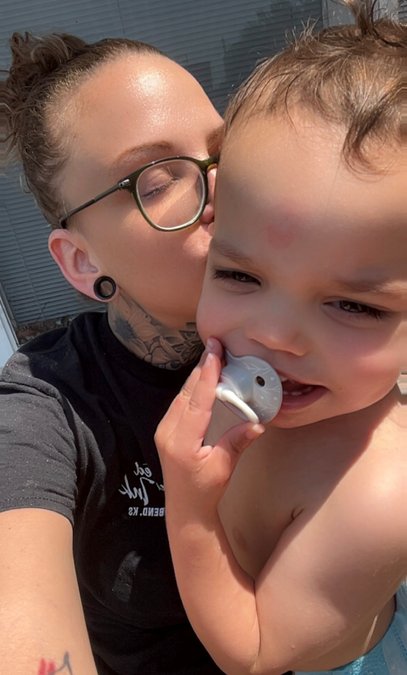
Hannah Gotchall remembers seeing her grandfather sitting in a chair beside her hospital bed.
He had been dead for years, having lost his own battle with lung cancer. But there he was, she recalls, as real to her in that moment as the pain and fear that had consumed her life.
Beside him stood something she could only describe as a human-shaped light.
And then came the words she has never forgotten.
“Not yet, Hannah. Not yet.”
Gotchall had just undergone a double mastectomy after being diagnosed with triple-negative breast cancer at 32 years old. Complications following surgery had left her drifting in and out of consciousness. She had blacked out trying to walk to the bathroom. She didn’t know what was happening to her body, or what would happen next.
But she remembers those words.
And she believes them more deeply today than ever before.
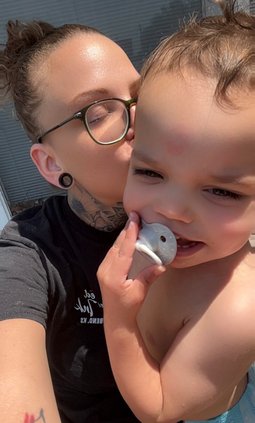
Because the young woman who once wondered whether she would live long enough to see another birthday is now the mother of a little girl she was told she would almost certainly never have.
Her name is Jubilee.
And to Gotchall, she is living proof that even in life’s darkest moments, miracles can happen.
Too young for cancer
In November 2022, cancer was the last thing on Gotchall’s mind.
She was just 32. She had her whole life ahead of her. And although she had discovered a lump in her breast months earlier, she had convinced herself it couldn’t possibly be anything serious.
“I found a lump and I knew something was wrong but I had been ignoring it for about six months,” she said. “I just didn’t think it could possibly be cancer. I was 32.”
When an unrelated illness sent her to the emergency room, she mentioned the lump to the doctor. She said her concerns were dismissed as the physician focused on treating what was believed to be food poisoning.
Still uneasy, Gotchall made another appointment, this time with a female provider.
The response was immediate.
“Right away she said something is wrong,” Gotchall recalled.
An ultrasound followed, then a biopsy. Her mother tried to reassure her, explaining that she had experienced breast cysts that needed to be drained. Perhaps, she hoped, that was all it was.
Gotchall wanted to believe her.
She went to the biopsy with a friend. Afterward, she remembers seeing the tissue sample left in the room, something she described as resembling onion roots.
Then came the waiting.
She was told to call if she hadn’t received results within three weeks. When that time passed, she called during her lunch break. Instead of giving her an answer over the phone, the office told her to come in immediately. Her mother accompanied her.
The provider looked at Gotchall and delivered three words that changed everything.
“Hannah, it’s cancer.”
“I freaked out,” she said. “My mom and I were both crying.”
It was triple-negative breast cancer, an aggressive form of the disease that does not have the hormone receptors or excess HER2 protein targeted by some common breast cancer treatments.
Gotchall was diagnosed at Stage 1.
“I didn’t even know there were different types of breast cancer,” she said.
Now she was learning more than she ever wanted to know. And she was terrified.
The future cancer threatened to steal
Before beginning chemotherapy, Gotchall’s medical team asked a question that would haunt her.
Did she have children?
She didn’t.
The doctors explained that the aggressive treatment could damage her fertility. They recommended that she consider freezing her eggs before beginning chemotherapy.
She explored the possibility, but the process seemed too lengthy when she felt she was running out of time. Her tumor had grown rapidly, she said, from something about the size of a pea to larger than a golf ball.
Waiting no longer felt like an option, so she chose chemotherapy.
And with that decision came the possibility that she might never become a mother. She began treatment the day after her 33rd birthday.
“By the time I got home after my first treatment, my hair was falling out,” she recalled.
For six months, chemotherapy became the center of her existence. She spent four to five hours receiving treatment each week, surrounded by patients who were often decades older.
One of her medications was nicknamed the “Red Devil,” a chemotherapy drug known for its bright red color. She remembers getting up to use the restroom and a nurse urgently stopping her.
“She said you’re going to think you’re bleeding but you’re not,” Gotchall recalled.
The medication had turned her urine blood red.
Another treatment brought sudden, excruciating stomach pain.
Sitting among elderly cancer patients, Gotchall felt she had no right to complain. They were older. They were sick. She was young. She thought she should be able to handle it.
When a nurse asked if she was OK, she insisted she was. But the pain quickly became impossible to hide.
“She said, ‘You’re not OK, are you?’”
The infusion was stopped. Her treatment had to be changed, and she returned the following day.
Five months into chemotherapy, she developed pneumonia. Her grandfather had died of lung cancer, and she became convinced the disease had spread to her own lungs.
She was admitted to the hospital in Hutchinson, but she remembers begging the staff at the Hoisington emergency room to let her stay closer to home.
“I was so afraid I was going to die and I just wanted to be close to home.”
She spent a week in the hospital. Her oncologist visited her every day.
“Oh my gosh, I was so tired,” she said.
But the physical exhaustion was only part of what cancer was doing to her.
The loneliness nobody sees
Cancer had taken away Gotchall’s sense of security. It had threatened her future and left her body exhausted. What she hadn’t expected was how lonely it would be.
She lived alone, often spending her days sleeping on the couch between treatments.
At work, she said, some coworkers made comments suggesting she received special treatment because she had cancer.
“Hannah gets away with anything because she has cancer,” she recalled hearing.
The words hurt.
She was undergoing harsh treatments, struggling to function and privately wondering whether she would survive. Yet she felt that because she was young, people expected her to prove just how sick she really was.
“When you’re young and have cancer, it’s like people expect you to wear a costume and show how sick you are or they think you’re being dramatic.”
Eventually, her doctor placed her on medical disability.
There were fears she couldn’t easily share, even with the people who loved her most.
“My parents were there but they were really struggling with wrapping their minds around this,” she said.
She needed to talk about things no 33-year-old should have to consider, things like funeral arrangements.
“I couldn’t really talk to them about the hard things,” she said.
She found support through an online group and leaned heavily on two friends who stayed beside her throughout the ordeal.
“I had two friends who I really don’t think I would’ve made it without them,” she said. “They were so supportive. Still to this day, they listen.”
Still, there were countless hours when she was alone with her thoughts. With her fear. With the possibility of a future she might never get to experience.
“Cancer is lonely,” she said. “People just don’t get it.”
“Not yet, Hannah”
Gotchall eventually made the decision to undergo a double mastectomy. She didn’t want to take chances with a disease that had already stolen so much.
“I didn’t want to play around with it,” she said.
She underwent surgery Dec. 30. Before the operation, she was told she needed painful injections to help identify the area being examined during surgery.
The nurse did not try to minimize what was coming.
“I’m not going to lie to you, it’s all going to hurt,” Gotchall recalled being told.
And it did.
“I remember coming off the table and screaming,” she said. “The anesthesiologist said I’m so sorry.”
Following surgery, she developed a hematoma and experienced repeated episodes of dizziness and lost consciousness. She remembers a nursing assistant helping her toward the bathroom when she blacked out.
Later, during one of those periods of altered consciousness, she saw her grandfather.
And the light beside him.
“Not yet, Hannah. Not yet.”
The next morning, she said, the dizziness was gone and she was alert.
Gotchall doesn’t claim to know how to explain what happened medically. But spiritually, she has no doubts about what the experience meant to her.
“I really believe God was that light beside my grandpa telling me not yet because I was going to have a baby,” she said. “He was saying you have a purpose.”
At the time, however, she had no idea just how profoundly her life was about to change.
A miracle named Jubilee
Cancer treatment eventually ended, although Gotchall continued receiving Keytruda infusions for months afterward.
She underwent breast reconstruction, a painful process that left her feeling as though she had bricks in her chest.
She struggled to raise her arms. The discomfort persisted far longer than she expected.
But she was alive.
She returned to work, although she knew she could no longer continue in the same job.
“I didn’t survive this just to go back to a job I hate,” she remembered thinking. “I want to help people.”
She became a certified nursing assistant at Clara Barton, the same health care system where her cancer had first been identified. She wanted to give back to the people who had helped her.
Then came an appointment that would change her life all over again.
Gotchall had gone to Clara Barton for a colonoscopy because of digestive problems she attributed to damage from chemotherapy. Her father accompanied her.
During the appointment, her doctor asked him to step out of the room so she could examine Gotchall privately.
Her heart sank.
After everything she had been through, Gotchall feared she was about to hear more devastating news. Instead, the doctor asked a question she could scarcely comprehend.
“Hannah? Did you know you were pregnant?”
She was stunned.
Chemotherapy had put her into medically induced menopause. She said she had been told her chances of having children were approximately 1%.
She had accepted that motherhood might be one more thing cancer had taken away. And now, against the odds she had been given, she was pregnant.
Her oncologist had a name for what had happened.
“That’s a golden egg.”
The news was especially extraordinary because just six months earlier, a friend had invited Gotchall to be in the delivery room when she gave birth, wanting her to experience something she thought she might never have herself.
Now Gotchall was preparing to bring her own baby into the world.
Her pregnancy was considered high risk, requiring additional monitoring and ultimately a cesarean section. But in November 2024, she gave birth to a perfectly healthy little girl.
She named her Jubilee.
“After all the trials and tribulations, she felt like a jubilation,” Gotchall explained.
After everything cancer had threatened to take from her, here was a little girl who represented everything she had fought to live for.
“She’s the biggest blessing in all of this.”
A different kind of fear
Surviving cancer and becoming a mother did not erase everything Gotchall had endured. There are still moments when fear creeps back in. Triple-negative breast cancer carries a risk of recurrence, and Gotchall knows that being disease-free today cannot guarantee what tomorrow will bring.
Her thoughts, however, are no longer focused only on herself. They are focused on Jubilee.
“I still get scared it’ll come back,” she said. “I want to make it to her 18th birthday. I worry about that a lot. I want to see her get married.”
For a mother who once believed she might never have a child, those ordinary milestones have become extraordinary hopes.
The first day of school.
Birthdays.
Graduation.
A wedding someday.
All the moments parents dream of witnessing, but rarely stop to consider as something they might not live to see.
Gotchall knows better.
She still sees her oncologist and undergoes regular testing. And as she approaches another milestone in her recovery, she is learning to embrace the language her doctor prefers — disease-free rather than remission.
“She told me she didn’t want me to jinx myself,” Gotchall explained.
She has also sought therapy to cope with the emotional aftermath of cancer.
“I’m so proud of myself because I went to therapy,” she said. “I used to be in such a dark cloud. I’m in a much better place now.”
The experience has changed how she sees the world.
Before cancer, she said, she carried anger and often focused on the negative. Now she tries to be more patient, to appreciate smaller moments and to let go of things that once seemed important.
It has also transformed her faith.
“I was never religious or even spiritual,” she said. “But now I know 110% there is a God and I have a purpose. I’m here to help people.”
As a nursing assistant, she believes her experience has made her more compassionate toward patients facing their own frightening diagnoses.
She knows what it feels like to be scared.
To hurt.
To feel alone in a room full of people.
And to desperately need someone who understands.
“I feel like I survived this so I could have a purpose,” she said.
For the woman who needs hope
Gotchall knows how frightening a triple-negative breast cancer diagnosis can be, particularly for a young woman who never imagined she was at risk.
She also knows the temptation to search the internet for answers, only to find stories that make the future seem hopeless.
“Google is the worst thing you can be looking at during this,” she said.
She has encountered the other side of cancer as well. While caring for a patient with triple-negative breast cancer that had spread to the brain, she experienced a panic attack.
It brought back the terror of her own diagnosis.
“I don’t know why some people die and others live,” she said.
She knows someone who lost her life to the same type of cancer. She knows another woman in the community who has recently been diagnosed. And she knows how badly she needed to hear from someone who had survived when she was the one sitting in an examination room, trying to comprehend the words, “Hannah, it’s cancer.”
That is why she is sharing her story.
“I felt very alone and isolated with it,” she said. “The diagnosis sounds so scary but you can come out on the other side.”
She urges young women not to dismiss a breast lump simply because they believe they are too young to have cancer.
If something feels wrong, she said, get it checked. And if concerns are dismissed, seek another opinion.
She is also growing out her hair, hoping to donate it as another way of giving back.
It is one more small act of kindness from a woman who knows what it feels like to lose so much.
But above all, she wants people to know that even when life feels unbearably dark, there can still be light.
“I want people to know miracles happen. They’re real,” she said. “Don’t get so discouraged in life that you start to believe good things don’t ever happen because they do.”
A reason to stay
Years before her own diagnosis, Gotchall remembers her grandfather, who was dying of lung cancer, urging her to quit smoking. He feared she could face a similar illness someday.
She was young. She thought she would be fine. She never imagined how deeply cancer would touch her own life. Years later, after surgery, she believes she saw him again.
And in that hospital room, when her future seemed so uncertain, she heard the words she would carry with her long after the physical wounds had healed.
“Not yet, Hannah. Not yet.”
Today, she believes she understands why.
There was still a daughter waiting to be born.
A little girl named Jubilee, whose very name celebrates joy after suffering.
A little girl whose birthdays Hannah hopes to celebrate, whose hand she hopes to hold through life’s milestones and whose future she desperately wants to be part of.
Gotchall cannot know what lies ahead. Cancer has taught her that life offers no guarantees.
But it has also taught her something else.
Even after unimaginable fear, there can be joy.
Even after devastating loss, there can be hope.
And sometimes, when a young woman has nearly given up believing in the future, life gives her a reason to dream again.
For Hannah Gotchall, that reason has a name.
Jubilee.