GREAT BEND - The first time she heard the words, “you have breast cancer,” she learned what it meant to be afraid – and what it took to fight for her life. She endured the treatments, the uncertainty and the days when simply making it to tomorrow felt like a victory. Eventually, cancer was something she could begin to put behind her.
Then she heard those words again.
For a second time, the life she fought so hard to reclaim was interrupted by breast cancer. Only this time, she entered the fight knowing exactly what it could take from her – and exactly how much she still had to fight for.
A nurse for 35 years, Kenya Lear’s first diagnosis came Oct. 17, 2011. She was 46 years old and a mom of four.
“I had a mammogram in September that was clear. In the beginning of October, I told the doctor something was going on so we did a biopsy,” she said. “My doctor called me with the results as I was driving home from seeing a hospice patient.”
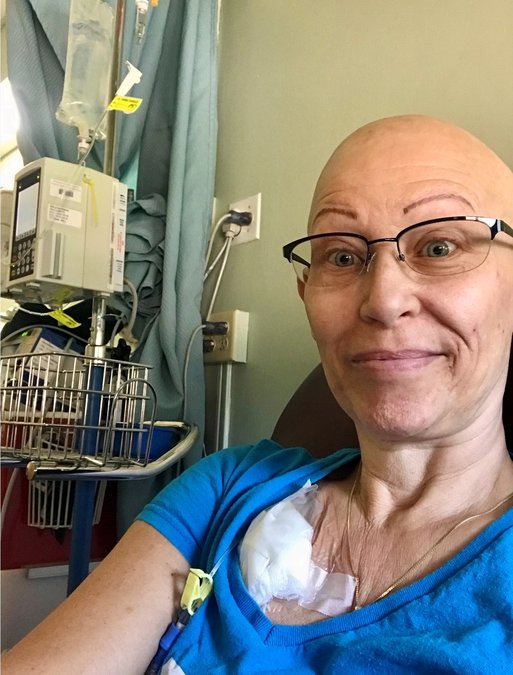
Lear began treatment Oct. 17; by Thanksgiving, her hair was falling out. She received treatment every other week for six months.
“I had all the symptoms,” she said. “I couldn’t work and man, I tried. My oldest was a freshman in college but the other kids were still at home.”
Lear’s diagnosis was stage 2 triple-positive breast cancer, which is a fast-growing cancer that tests positive for estrogen receptors, progesterone receptors, and HER2 proteins. However, it has a very favorable five-year survival rate of about 95 percent when treated. All of her chemotherapy was performed in Great Bend. However, her bilateral mastectomy was performed at Hoisington.
“That was kind of unheard of,” she said. “I was scared to death but Dr. Robin Durrett’s (one of her surgeons) wife was so wonderful and shared her experience. That’s why I have to share mine. I have to be an open book for anybody because there is absolutely a fear factor.”
Lear’s reconstructive surgery was performed at the same time. In February, 2019, she was still doing yearly checkups when she raised her arm and discovered a lump under her implant.
“I saw my doctor again and he said let’s just check it,” she said. “I had been on a chemo pill for four years but it obviously didn’t work.”
Lear was sent to a specialist in Wichita because of the implants where they did an MRI that came back clear. Her breast specialist looked at the spot and decided that since it was bothering her, they would do a sonogram and see if it was something they could remove.
“She did a biopsy and called the next night to say it’s back,” she said. “My oncologist said we’re going to hit you harder because your body remembers.”
Lear did chemotherapy every three weeks for another six rounds. Her doctor wanted to begin treatment a week before her youngest daughter graduated from high school.
“I said no – that little girl was 10 when I started the first time; I’m not interrupting her graduation,” she said. “The doctor said you scare me sometimes but I said the chemo is going to going to control my life for several months and this is what little control I have left.”
She began treatment the day after her daughter graduated.
“It knocked me hard on my butt and radiation was hell; but you do what you have to do. You don’t complain; you don’t whine,” she said. “People asked if I was angry and I really wasn’t. If this is a part of my journey – my life was written far before I was born.”
During that time, Lear’s mother was in hospice in Missouri.
“I showed up with really short hair that second time but didn’t want to trouble her so kept my diagnosis from her,” she said. “She died in the middle of my second treatment.”
Lear had an explant procedure and was unable to have her implants replaced for 18 months because of Covid.
“I had a huge infection on the left side and they had to go in and debride it,” she said. “My husband hated having to wait in the car while they did that.”
Lear said when her cancer came back, her daughters were scared. Her youngest was actively trying to get insurance to approve a breast reduction to reduce the amount of breast tissue. She was denied.
“When my cancer came back the second time, they quickly approved it,” she said. “She said, ‘Mom, do I do this?’ I said absolutely – you need to be proactive for yourself.”
Her oldest daughter had amassed years of worsening markers and opted for a prophylactic bilateral mastectomy.
“She asked me if she was being selfish. She said I watched you do this twice and I don’t want to do the same thing,” Lear said. “I said I don’t want you to do the same thing.”
Doctors told her daughter that within six months, she would have been stage 1 or stage 2.
“My oldest daughter was starting to be afraid,” she said. “That’s when it’s time to do something.”
She said there’s a great deal of fear surrounding your diagnosis.
“Fear of death – fear of what my life will look like after cancer and treatment,” she said. “But if I had to do it again, I would. You learn things about yourself you didn’t know; and it changes you in the ways you needed to be changed.”
After having her implants removed, Lear didn’t want to go that route again.
“I ended up having a deep flap surgery where they take the skin and fat layer from your belly and move it to your chest,” she said. “My doctor in Wichita is one of few who do it and it’s a 12-hour surgery.”
Lear said the surgery is risky with only a 50 percent success rate. She spent three days in the Intensive Care Unit but her surgery was a success.
“I’m thankful every day for the advancements in medicine,” she said. “I’d tell young women to take advantage of the medical advances but never forget self-care.“
After her second fight with breast cancer, Lear tried to return to work as a hospice nurse.
“I took care of a man I had done treatment with; he requested me,” she said. “He said you made it and I’m not. I wanted to be there to help him with his journey to get to the end but I just couldn’t be there when he passed.”
After that, Lear took a hiatus from nursing before accepting a position in nursing management.
“But I just couldn’t do it,” she said. “I did learn a lot about being a patient, however. It taught me a lot about when you have no control and about what caregivers go through.”
Lear credits her family, her six siblings, and her church for helping her through both diagnoses.
You look at things a whole lot differently; you don’t waste the moments and don’t put them off,” she said. “Don’t say I’ll do that tomorrow or I’ll visit someone tomorrow.”
Lear said it’s important for her to be a listening ear to others.
“This experience was positive – I learned so much,” she said. “I’m a better caregiver, better Mom, a better Christian, better friend and better listener.”
After her experience, she has decided to start a cancer ministry at her church.
“I told my pastor when this all started; we’re going to win. We were always going to win,” she said.” But I know everyone has the same anxieties, the same questions and concerns and who is there to listen? Who’s there to help them?”
Lear said when someone has cancer, everyone in the family has cancer.
“You have to be willing to adapt; willing to move forward,” she said “It’s a journey and your attitude on the journey is how well you’re going to travel it.”