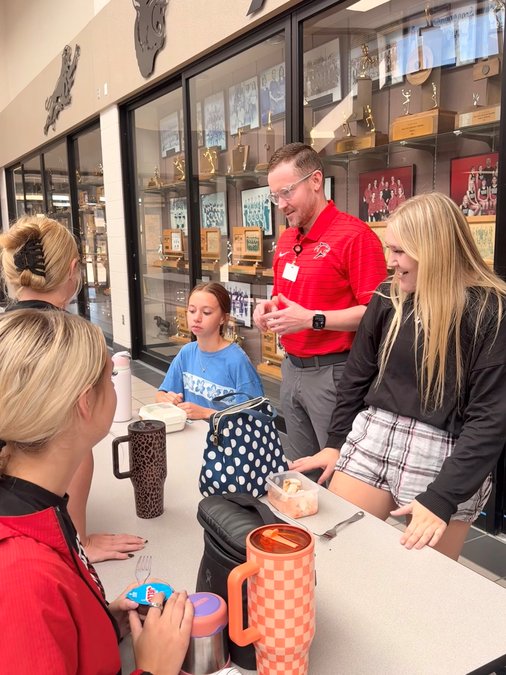
The lunchroom at Great Bend High School is getting louder, and Principal Brock Funke couldn’t be happier about it.
With students no longer allowed to use cellphones during the school day, something that once seemed ordinary is making a comeback: conversation.
“The positives we’re seeing is the lunchroom is loud because kids are talking again,” Funke said. “I would say communication skills have improved just dramatically.”
For Funke, who is in his third year as principal, those conversations represent something much bigger than a change in school policy. They reflect what he believes education should be about — building relationships, developing character and helping young people become better versions of themselves.
“Our whole staff is here for kids,” he said. “I know schools and education as a whole right now, in some cases, is getting a bad rap — public education. This school, this place, everybody in this building would absolutely do anything for a kid.”
It’s a philosophy rooted in his own experiences growing up in Washington, Kan., a small town of approximately 1,000 people.
“I loved school and being with my friends, but I only did enough to get by,” Funke admitted. “I was a little ornery, but I was fortunate to have good teachers and parents that held me accountable.”
One teacher in particular left an impression that would eventually shape Funke’s approach to education and leadership.
“He was a junior high and high school teacher who was a Vietnam War vet,” Funke recalled. “He expected our best every single day. He was strict and held us accountable.”
As a teenager, Funke didn’t necessarily appreciate those expectations. As an adult, he understands what was behind them.
“When you’re a kid, you can’t really see what he was doing, but I see it now. It was his way of caring,” he said. “He held us accountable to help us be better people.”
Years later, when Funke returned to Washington to teach, that same teacher was working as a substitute.
“Him having the biggest impact on me had nothing to do with an activity or a lesson he taught,” Funke said. “It was the care and love he had for us. He wanted us to be better people.”
That lesson has stayed with him.
“That’s how I operate. I am very honest with the kids,” he said. “They want you to talk to them like they’re human beings. Show them your respect. You have to have high love to equal high expectations.”
Finding his calling
Funke didn’t initially plan to become an educator.
He enrolled at Fort Hays State University intending to pursue a career in radiology, but something didn’t feel right.
“I felt like something was missing,” he said. “People always said I was good with kids, and as soon as I started, I realized this is where I should be.”
After earning his degree in elementary education, Funke began his career at Park Elementary School in Great Bend, where he taught fifth grade for four years before serving another four years as an instructional coach. He also earned a master’s degree in education, specializing in English for speakers of other languages, from Newman University.
Although he enjoyed teaching, becoming a principal was always a possibility in the back of his mind.
“I wanted to do the most I could to help students,” he said. “My goal has always been to help them become better people. I read something that said the person who can make the most impact on students is the building principal, so I wanted to do that. That’s my passion.”
After eight years in Great Bend, Funke returned to his hometown, first as a teacher and later as principal for grades seven through 12.
“I wanted to see what it would be like to go back to your hometown and teach,” he said.
But Great Bend had left its mark on him.
When he was encouraged to apply for the high school principal position, Funke saw an opportunity to return to a community where he believed he could make a difference.
“I enjoyed going home, but I always felt like when I was here, I could see and feel my impact,” he said. “There was a higher need from students. I wanted to make sure our young people have people in their lives to support them.”
Now leading a school of about 863 students and 120 staff members, including 70 teachers, Funke has discovered that being a principal is both what he expected and nothing like he imagined.
“As a teacher, I thought I knew what a principal did, but once you start doing it, it’s a whole different world,” he said. “The transition from teaching to being a principal wasn’t as difficult as I thought. I’m happy I have some natural ability with it.”
One thing he’s learned is that flexibility isn’t optional.
“Whatever you have planned as a principal is probably not going to happen,” he said. “I’ve never had one day the same as another. You just never know.”
Still, he wouldn’t trade the job for anything.
“It’s something I’m blessed to do,” he said. “I don’t see it as a job.”
Creating a culture of caring
Ask Funke what he wants people to notice when they walk through the doors of Great Bend High School, and his answer has nothing to do with test scores, trophies or academic rankings.
“I would want them to notice the smiles on kids’ faces,” he said. “I would want them enjoying being here. I also want people to feel welcome and respected.”
Creating that kind of environment takes intentional effort from everyone in the building.
“No matter how good the culture is at your school, you always want it to be better,” Funke said. “Our students and teachers show up every single day and are here to support each other.”
That support doesn’t mean lowering expectations.
“When we’re in this building, we treat each other kindly and care about each other,” he said. “Does that sometimes mean being held accountable? Yes. We teach how to work with others, how to communicate. Making them a better person is the main goal.”
The school uses the Capturing Kids’ Hearts program, which emphasizes relationships and a positive school culture.
“The whole goal is to make students feel welcomed, cared for and loved,” Funke said.
He believes the same philosophy applies to leading teachers, particularly as the demands on educators continue to grow.
“You’ve got to be positive. You’ve got to bring the energy all the time,” he said. “You’ve got to be the light.”
Just as importantly, he wants staff members to know they have his support.
“I let them know my door is always open.”
Challenges beyond the classroom
While Funke is encouraged by the school’s culture, he recognizes that today’s students face pressures previous generations didn’t experience.
“Some of the biggest challenges students are facing today are each other. Social media. Peer pressure. Bullying,” he said.
The difference, he believes, is that technology has made it nearly impossible for students to escape those pressures.
“Back when I was a kid, we could disconnect. These kids don’t get a break,” he said. “If someone is giving them a hard time, when they leave for the day, it doesn’t stop.”
He encourages parents to pay attention to what their children are experiencing online.
“I always encourage parents to check their kids’ phones,” he said. “It just doesn’t stop. That’s a weight and amount of pressure I would not want.”
That concern makes Kansas’ new school-day cellphone restrictions particularly significant.
Funke acknowledged that implementing the law has presented challenges, including getting everyone on board with the changes. But he believes the benefits are becoming apparent.
“I’m pleased with how it’s started, but I think with the law, there have definitely been some challenges with it,” he said. “It was tough getting everybody on board.”
Still, he sees the restrictions as a positive step.
“If you actually go through the data and research, having a cellphone isn’t helping,” he said. “It’s absolutely a distraction.”
Beyond technology, Funke believes one of the most important responsibilities of educators is recognizing when a student is struggling. “Constant communication with the staff is key,” he said. “If you see anything or hear anything, communicate with myself and the counseling department.”
But identifying problems begins with establishing trust.
“The importance of building relationships with your students,” he said. “Our kids need someone they feel comfortable talking to or opening up to.”
A community effort
For Funke, building a successful school doesn’t end at the classroom door.
He sees parents, businesses and the broader community as essential partners, particularly when it comes to attracting and retaining quality teachers.
“We have to have things to draw people to our community,” he said. “We always see people leaning more east for teaching positions. The more the community can grow and find things to attract families, the more helpful it is in recruiting and retaining teachers.”
He’s encouraged that four or five GBHS graduates have returned to begin teaching careers in the district within the past couple of years.
Maintaining positive relationships with parents is equally important.
“Parents having a positive relationship with the school comes down to communication,” he said. “That’s why it’s important for me to be consistent in communication. Being committed with us and working with us to help their kid grow and get better.”
Funke is particularly appreciative of the support he receives from throughout the district and community.
“The one thing I appreciate most about this district and community, and why I think good things are happening and will continue to get better, is the support of everybody,” he said.
“The district administration, community and parents are all just phenomenal. There are so many amazing people in this community. If I picked up the phone and needed help, everyone would do it in a heartbeat.”
That kind of support, he said, isn’t something every school enjoys.
“Support like that isn’t common, and it’s greatly appreciated. I can’t thank them enough.”
Beyond the principal’s office
When he’s not navigating the unpredictable demands of running a high school, Funke enjoys spending time on the golf course.
Last summer, he and a group of friends even organized their own golf tour, playing six different courses over approximately a month.
There was, however, one problem with the competition.
“Chad Premer is not invited back — he’s too good!” Funke joked.
“It was a lot of fun.”
It’s a glimpse of the personality behind a principal who admits he was once a little ornery himself but now spends his days encouraging hundreds of teenagers to make good choices.
And while he takes the responsibilities of his position seriously, Funke’s ultimate measure of success is surprisingly simple.
He doesn’t expect every student to remember a particular lesson, assignment or accomplishment.
Instead, he hopes they’ll remember how they felt when they walked through the doors.
“I hope years from now when students look back on their time in our building, they think that was a fun place where I was cared for and got better as a person,” he said. “Because really, that’s what they’ve told me they want school to be.”
“I want every kid to be able to come here and not have to worry about all this stuff — just be themselves and be with their friends. That’s all I want.”