The phonics workbook line read, “A rat sat.” (A prime example of the dramatic plotlines available to nascent readers.) After finishing the rest of R’s page, Benson colored the provided picture of a rat in an unexpected fashion: standard gray for its head and part of its torso, but also wearing red-and-white-striped pantaloons of some sort.
When Brian came in that evening, we had him guess who the rat was. “Ralph? Ratatouille? Mr. Rat?” Apparently rats are often named alliteratively, since the real answer was Reepicheep — the courageous warrior leader of the talking mice of Narnia.
Wait a minute. I just ruined my own segue. Why did it not occur to me before right now that Reepicheep is a mouse and not a rat? I believe this is what’s called stream of consciousness writing.
If Reepicheep were here, I’m quite certain he would take major offense at me so grossly misrepresenting him, yet at any rate his depiction brought about deliciousness. No, I did not cook either a mouse or a rat; I’m a fan of wild game, but you gotta draw the line somewhere. (At mice and rats, that’s where.)
But Brian’s guess of Ratatouille brought ratatouille to my mind, and there it scampered around like you know what. Ratatouille is a lovely dish to plan to make, and also a lovely dish to just make with the random bits of the last veggies of this garden season.
I will always be quick to assert that eating in season provides a bounty of blessings, and in fact, the value of eating locally (which by correlation includes seasonally) is the main premise of my entire column. The original assignment over nine years ago was to write about our county farmers market and what our local neighbors brought to offer there, and I spent the first many weeks positing the various arguments for supporting a lifestyle attached to the seasons and the community in which we live.
I am deeply committed to all of that still, and anticipate always being so. I took thousands of words to articulate just a few of my perspectives on the multifaceted benefits of and reasons for living with the seasons, so unless I plan to revisit those (which I just might eventually), I should wind myself down before I get started going and can’t stop.
With all that said, though, I will also be the first to acknowledge that eating local is far easier said than done. Right alongside the reasons for are viable reasons against, and while I wouldn’t say that I have become jaded, I am perhaps less starry-eyed about the full-scale pursuit of local life when put into real time — there is just far too much nuance.
And let’s be honest, eating seasonally is way more fun in the “right” season: and by that I mean, tomato and watermelon season. Those might be the greatest good in that time frame, but their peak corresponds with many of the other summer garden gifts, so there is a plethora of fresh produce. (At least hypothetically; extra tomatoes have been harder to come by this year.)
As I discussed last week, we are about to leave the “right” season behind — sooner rather than later, I’ll have to stop expecting local summer produce. But for now, it’s mighty delicious, and I reveled in each bite of ratatouille. Just don’t tell Reepicheep.
Summer’s End
Caponata
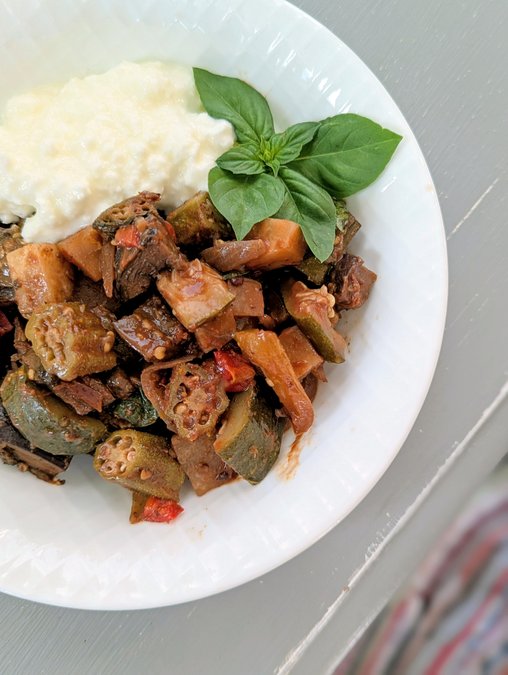
Just as I misrepresented Reepicheep the mouse to you, this whole time I’ve been misrepresenting caponata the not-ratatouille to you. I want to say it’s basically the same thing, but that might get a Reepicheep-style violent response from both the French (ratatouille) and the Sicilians (caponata). The star veg are the same — except not exactly in my version, since I added some local flair — but caponata adds sweet and sour notes. We’ll be over here waiting for the Caponata movie to come out.
Prep tips: it might feel like a lot to cook the veggies in stages, but really you’re only using one skillet and getting the right cook on each, so it’s worth it.
- ¼ cup good olive oil
- enough wimpy eggplants to equal 1 pound
- 1 zucchini, your choice of size
- 1 large onion
- 1 red bell pepper
- 1 kohlrabi, if you’ve got it
- a handful of okra
- ⅓ cup red wine vinegar
- 2 tablespoons local honey
- 1 tablespoon tomato paste
- a generous handful fresh basil
To prep, cut all veggies into about 1-inch cubes. Then heat about half the oil in a large nonstick skillet until very hot; add in the eggplant plus a sprinkle of salt, cover, and cook, stirring occasionally, until it’s nicely browned. Remove from skillet, heat half the rest of the oil, and cook the zucchini with a sprinkle of salt, covering and stirring occasionally until lightly browned. Remove, and repeat with the remaining vegetables in one last batch. Once those are cooked, stir in the vinegar, honey, and tomato paste, and cook for a couple minutes. Stir eggplant and zucchini back in, season with salt and pepper, and serve any temperature, stirring in the basil last minute. Serve with a bunch of cottage cheese or ricotta to take it over the top.
Lettuce Eat Local is a weekly local foods column by Amanda Miller, who lives in rural Reno County on the family dairy farm with her husband and three small children. She seeks to help build connections through food with her community, the earth, and the God who created it all. Send feedback and recipe ideas to hyperpeanutbutter@gmail.com.