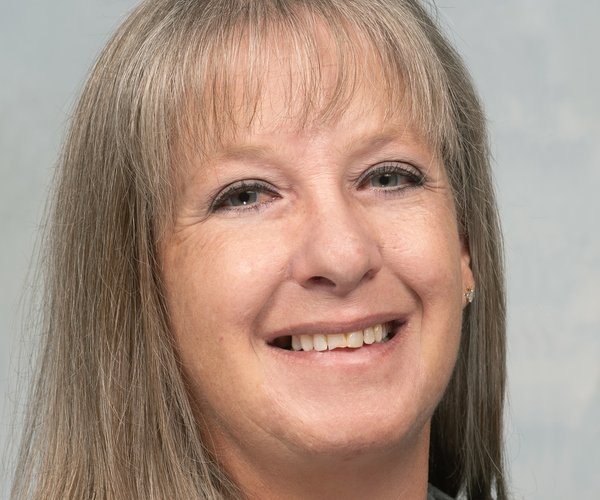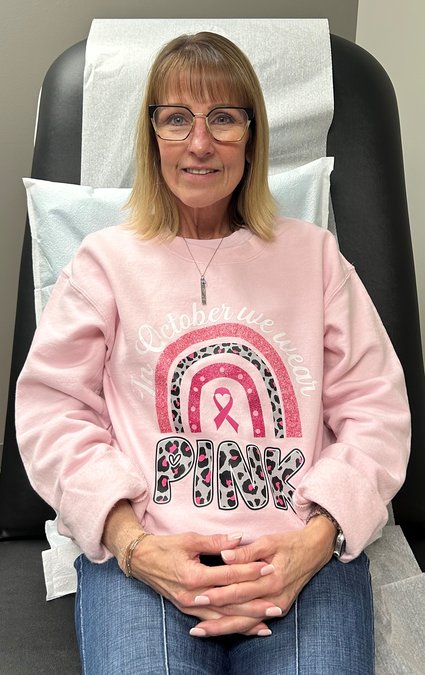
After a yearlong battle with breast cancer, on Oct. 13, 2026, Angie Miller asked her doctor when she could finally call herself a survivor.
His answer? Today.
“I cried,” she said. “All I could think of was I did it!”
Her journey began Oct. 16, 2025, when she discovered a lump in the shower. A mammogram just two months earlier showed no signs of cancer.
Miller works at the surgical center at Clara Barton, so the next morning, she asked the nurse manager to check it.
“She said let’s just have it checked,” she said. “I work with Dr. Jeremy Howes, who comes in from Wichita. He recommended an ultrasound.”
The ultrasound technician told her something “just wasn’t quite right.”
“The radiologist said he couldn’t say for sure if it was positive or not so they ordered a needle core biopsy,” Miller explained.
The pathology report identified an abnormality in the mammary tissue, but the finding did not appear to correspond with the lump Miller felt higher in her breast. The doctor remained concerned so he ordered an excisional biopsy.
“I’m lucky I work where I do because I was able to get this all done relatively quickly,” she said.
She received the news on Nov. 26, 2025, the day before Thanksgiving. She was 59.
“Prior to that, I just knew in my gut it was cancer,” Miller said. “My husband and I talked in depth about my options and I opted for a double mastectomy.”
That was performed Dec. 4, 2025, at Clara Barton Hospital in Hoisington.
“Even though I was prepared and knew it was probably cancer, hearing the words was a smack in the face. How can I be the first in my family?” she said. “My second thought was I have two little sisters and a daughter. Do they have to worry about this? It was just such a wave of emotion.”
She was diagnosed with ER-positive, PR-positive, HER2-negative (HR+/HER2-) breast cancer. It’s a type of cancer where the cells grow using estrogen and progesterone hormones as fuel, but do not have excess HER2 protein. This is the most common subtype of breast cancer, accounting for about 70% of all cases.
“I was on estrogen and progesterone for 15 years; it was hormone driven,” she said. “I have no history of breast cancer in my family.”
Miller’s oncologist diagnosed her cancer as stage 2, but only because of its size.
“It was 8 millimeters and anything over 7 mm is considered stage 2,” she said. “But I had no lymph involvement.”
Miller had implants prior to her diagnosis so her surgery involved removing any remaining breast tissue.
“I did very well,” she said. “I do have some deformities and will see a plastic surgeon in December to see if there are any options. But if not, that’s just God’s way.”
Miller added that while no one ever wants to receive a breast cancer diagnosis, she felt very lucky.
“I had the best-case scenario and didn’t require any additional treatment such as chemotherapy or radiation,” she said. “I count my blessings every day.”
Her oncologist said she was again fortunate in how her surgery was performed.
“He said he’s seen many times where they will do the reconstruction immediately after the mastectomy. Then the margins aren’t clear and they have to do a second surgery,” Miller said. “He said he was very glad in how I have done my breast cancer journey. If they do reconstruction, they won’t have to worry about cancer cells in the tissue.”
Miller began taking letrozole in January and will continue for at least five years to try and prevent the cancer from returning. She visits her doctor every three months for lab work and will undergo a CT scan annually. Because of the medicine she’s taking, she also receives a Reclast infusion every six months.
“The medicine depletes bones so it helps me hang on to the bone density I have,” she said. “I have osteopenia and hopefully it keeps it from turning into osteoporosis.”
Miller advises anyone recently diagnosed with breast cancer to keep a notebook. She used one to take notes at every appointment and write down any questions she had.
“Once you get there, it’s hard to remember your questions,” she said. “In the beginning, it’s completely overwhelming with all the appointments, lab work and tests. My notebook tells everything – it’s literally my whole story.”
Miller said she had a strong support system throughout her journey.
“My husband is my rock and my greatest source of strength,” she said. “But it affected him horribly. He hated to see me worry. He hated to see me sad. He hated I had to go through this, but he was so strong for me. He’s an incredible human.”
When Breast Cancer Awareness Month came this year, Miller and Macy Ingham, a coworker, decided to make shirts.
“It hung heavy on my heart so we did a ‘support squad’ shirt and marked them up $1.50,” she said. “With the proceeds, we were able to donate $200 to the Breast Friends Support Group.”
Her employer, Clara Barton, also agreed to allow employees to have Jeans Wednesdays in October for $5. Miller and Ingham plan to donate those proceeds as well. Their goal is $500.
Her advice to others diagnosed is to lean on your family and friends.
“Accept help when offered,” she said. “And don’t feel weak when you accept that help.”
To Miller, performing self-breast exams is just as important as mammograms.
“I felt very lucky I’m so good about doing those self-exams. I caught it very early,” she said. “If I hadn’t, it may not have been found and the outcome may have been very different.”
She encourages women and men to get to know their bodies.
“Know how your body feels so when there’s something different, you recognize it,” she said. “Know your body; advocate for yourself. If you don’t think it’s right, push. Just push.”
Through her experience with cancer, Miller discovered she’s stronger than she had realized.
“I’ve also learned not to take anything for granted. I consider every day as a blessing and try and make the most out of it,” she said.
“Tell the people you love that you love them. Finally, just be a kind person – you never know what people are going through.”