Editor’s note: This is the first of two stories about a program that took place on Thursday, describing why people are being asked to vote for a three-quarter cent sales tax in Great Bend. Mayor Alan Moeder also plans to answer community questions about any aspect of city business in a new column that will appear in the Great Bend Tribune. Send questions to news@gbtribune.com with the subject line “Ask the Mayor.”
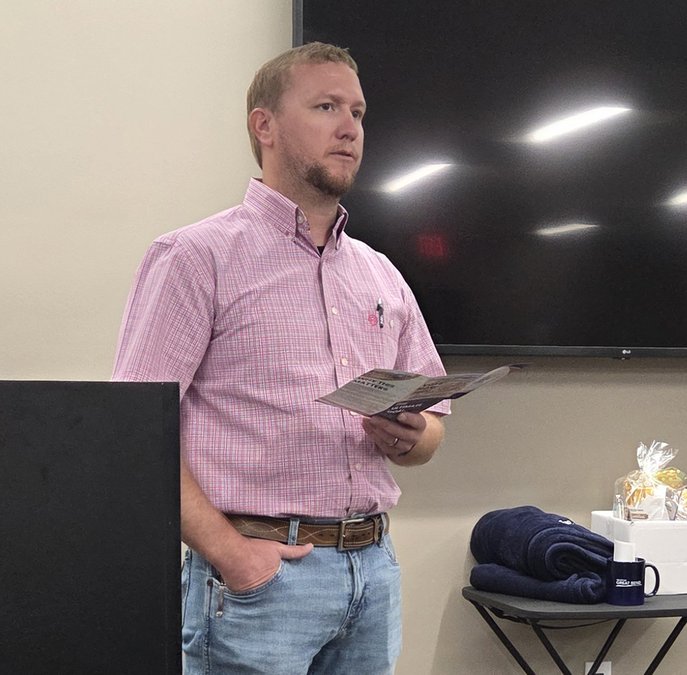
City officials continue to share information about a proposed three-quarter cent sales tax that will be on the November ballot. On Thursday, the City of Great Bend hosted a Great Bend Chamber of Commerce Coffee and described the plan to an audience of chamber members.
City Administrator Logan Burns said the proposed tax would start with a quarter-cent for property tax relief, with the remaining half-cent for infrastructure. The infrastructure portion can be broken down further: a quarter-cent will be devoted to upgrading the city’s wastewater treatment plant. The remaining quarter-cent could go toward financing a STAR Bond project, which the city council is likely to approve if the sales tax is approved. No more than a quarter-cent could be used to support the Star Bond, and once the sales tax is no longer needed for that, the money could be applied to other infrastructure needs, such as improvements to the water system.
If voters approve the tax in November, the city will start collecting money next April.
Great Bend already has a sales tax:
- 6.5% is imposed by the State of Kansas
- 1.0% is imposed by Barton County
- 1.2% is imposed by the City, with the proposed rate increase bringing that to 1.95%
That would bring the total sales tax to 9.45%.
Burns said that even with the increase, Great Bend would be “in the middle” in comparison to what people pay in other communities.
A city brochure also shows the cost. A three-quarter cent tax would add 75 cents to the cost of every $100 purchase and $7.50 for every $1,000 purchase. For every $40,000 spent on taxable items, it would add $300, which is about what residents can expect to pay for increased sewer fees if the sales tax doesn’t pass.
“That ($300 a year) is what we’re talking about on the wastewater treatment side of what the sewer rates would have to go to in order to do a rehab on the wastewater treatment plant,” he said.
WWTF
“Our wastewater treatment plant is in dire need of a rehab at this point,” Burns said. “We don’t have any more time to wait. It is time to do something.” Costs are estimated at $26.3 million. The plant was built in 1954 and its last “major rehab” was in 1997.
The city budgets $325,000 a year for maintenance, but that doesn’t cover the scope of items found.
The city ordered a study last year from its on-call engineering firm, JEO and the council went through its details in March and April. About three months later, issues at the plant started presenting themselves, he said. “We thought we had about five years before a lot of them hit.”
The city has applied for a Kansas State Revolving Fund (SRF) grant for $26.3 million, which would be eligible for $1 million in loan forgiveness and a favorable interest rate.
In addition to that, he said, the city officials approached Sen. Jerry Moran when he visited Barton Community College last April. “We requested just shy of $4 million in congressionally directed spending funds from him. I’m hoping we will find out in October if we are able to get those funds.” If that happens, it will lower the amount of the SRF request.
Mayor Alan Moeder told the audience 1.2 million gallons of water goes through the wastewater treatment facility every day.
“One of the questions we get asked all the time is, ‘Why didn’t we plan for this?’ We didn’t expect this to happen, and people that were in charge 10 years ago didn’t expect this to happen. It’s happening, and now we’ve got to take care of it. And it’s an urgent need,” he said. “If that goes down, we have to shut the water off.”
Moeder noted that there are federal Environmental Protection Agency codes that the facility is required to meet. “And EPA is changing some of the codes in the next five years, so we’re mandated to build part of it new, anyway, to meet the requirements.”
An audience member asked what could happen if the city does nothing.
“The state of Kansas will come in and run our plant, and they will charge us regardless,” Burns said.
Money from visitors
Annually, 3.5 to 4 million people come through Great Bend, Burns said. There are 6,600 water meters in town. The cost of the project could be added to their fees, or a sales tax could take advantage of all retail spending done in town.
“That’s why we went the sales tax route,” Burns said. “We would rather change sales tax to those 4 million people that use all the services, rather than charging everybody on their 6,600 water meters in town.”
One audience member said a point that was made at the Aug. 25 Town Hall was worth noting. A $20 a month increase on utility bills today could turn into a $50 a month fee 10 years from now, due to inflation.
But inflation will cause a 1% sales tax to bring in more money each year, and if the city grows it could bring even more.
No sunset
The city already has a quarter-cent sales tax dedicated to street repairs that is scheduled to “sunset,” that is, come to an end, next year unless it can be renewed.
And a one-tenth cent sales tax to pay for the new Great Bend Police Department building will end once that debt is paid off, probably in 2037. But infrastructure needs are ongoing, which is why the proposed tax does not have a sunset clause, Burns said. “It’s going to have to be something you continually invest in way down the road.”