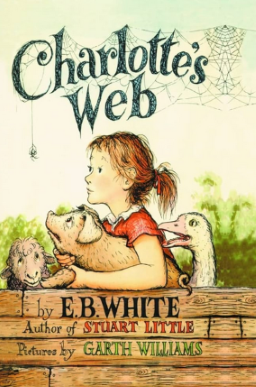
We’ve seen the lists of classic books that were banned at one time or another. I was looking at a table stacked with such books and saw many familiar titles: “Fahrenheit 451,” “Catch-22,” “The Adventures of Huckleberry Finn,” “Charlotte’s Web —”
Wait, “Charlotte’s Web”? Why was that book banned?
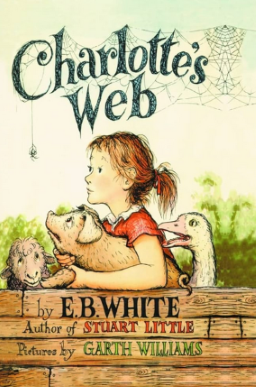
The book by E.B. White is one of the most widely read children’s classics in the world. But in 2006, a parent group in Kansas reportedly challenged its place in school libraries. According to Business Insider, there were two objections. One was the theme of death: the title character, Charlotte, is a spider whose naturally short lifespan (spoiler alert) comes to an end in the book. The objection that makes me laugh is the other one — that the book’s characters are talking animals, which some considered “unnatural and blasphemous, as humans are the highest level of God’s creation.” (Charlotte can also write, spinning letters on a web. She writes “some pig” and other special words about her friend Wilbur, to keep him alive.)
Accounts of this attempted banning describe it as an isolated, localized challenge rather than a widespread ban, and honestly, I wonder if the story is even true. Maybe it was satire, or maybe it was invented to make a “banned books” display feel more shocking. The parent group and the school district involved have never been identified, which makes me skeptical.
That got me curious about why other books have landed on these lists.
“Catch-22” contains profanity, cynical anti-war themes and sexual references, which have led some school boards to challenge it. “To Kill a Mockingbird” and “Huckleberry Finn” both contain the N-word and depictions of racism. “The Bluest Eye” by Toni Morrison is frequently challenged because it depicts child sexual abuse, incest and rape.
Ray Bradbury’s “Fahrenheit 451” is sometimes pulled from schools, or has certain words or chapters removed, because its characters discuss drugs and use minor profanity and religious references. I find myself wondering if this novel still raises objections in 2026 — perhaps it was more shocking when it was published in 1953, and the culture has simply caught up to it.
Most books haven’t technically been “banned” in the United States, though they may be kept off library shelves — especially in schools — or placed in restricted sections. When I was in high school, we needed a parent’s permission to check out “The Exorcist.” I’m still not sure what age that book is appropriate for, but I was allowed to read it.
The American Library Association releases an annual list of the most challenged books. Here is the ALA’s Top 11 for 2025:
“Sold” by Patricia McCormick
“The Perks of Being a Wallflower” by Stephen Chbosky
“Gender Queer” by Maia Kobabe
“Empire of Storms” by Sarah J. Maas
“Last Night at the Telegraph Club” by Malinda Lo
“Tricks” by Ellen Hopkins
“A Court of Thorns and Roses” by Sarah J. Maas
“A Clockwork Orange” by Anthony Burgess
“Identical” by Ellen Hopkins
“Looking for Alaska” by John Green
“Storm and Fury” by Jennifer L. Armentrout
Language or behavior in a book may offend someone’s religion, sense of morality or politics, but the book as a whole can still offer a compelling story and a genuine learning experience. According to PEN America, the 52 most banned books of the last four school years include National Book Award and Pulitzer Prize winners, bestsellers, and beloved works by authors like Toni Morrison, Margaret Atwood and Judy Blume.
The book banned today may be the classic assigned in class 10 years from now. A spider spinning “Some Pig” into her web didn’t corrupt a single child — it taught generations of them how to read for wonder, and how to grieve. That’s the real danger banning lists never seem to account for: not that kids will read the wrong thing, but that they’ll learn to think for themselves.
Susan Thacker is the managing editor of the Great Bend Tribune. Send email to sthacker@gbtribune.com.