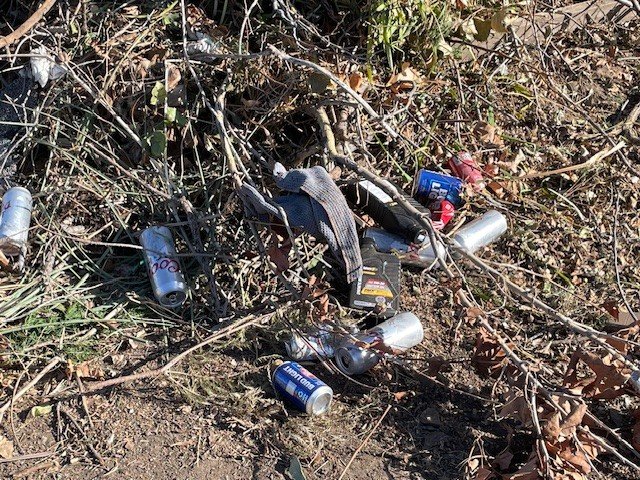
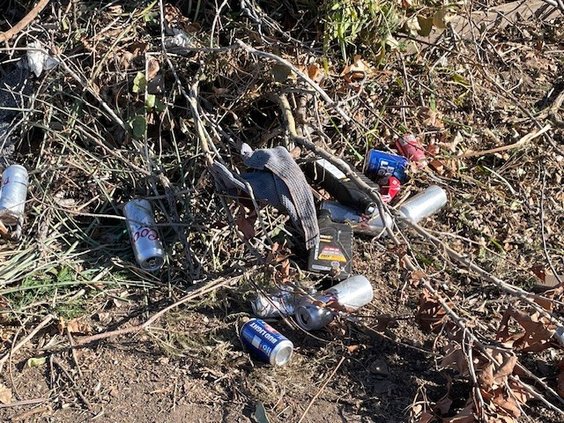
Public Works Director David Dunekack came to Monday’s Great Bend City Council meeting with 20 photos of illegal dumping and other improper use of the compost site south of town at 97 SW 5th Ave.:
- Someone dropped off part of their fence.
- There was a pile of aluminum cans and miscellaneous trash.
- Somebody dumped a birdbath, a weed barrier tarp, grass trash, and a piece of a bed frame.
The list goes on.
Improper use of the free facility is unacceptable, he said, and if it continues, the site will no longer be open 24/7 as it is now.
Mayor Alan Moeder said the city is willing to turn cases over to law enforcement.
“I want to remind the public — there are cameras out there, and we will start fining people,” Moeder said.
“The compost site is neither a landfill nor a trash dumpster,” Dunekack said. “It’s a place for citizens to deposit grass, tree limbs, and other woody or herbaceous, grass-like plants. There are three different sets of signs at the compost site that explain in detail what is acceptable.”
Grass and other grass-like plants go in the grass pile. Tree limbs and other woody-type plants go in the tree pile.
“Back your trailer up to the grass pile, please. I know everyone’s in a hurry, but be patient and wait until there’s room for you to get as close as possible to the pile. This will save on diesel fuel consumption and hourly wages.”
When the Barton County Landfill increases its rates in July, Dunekack hopes that doesn’t lead to more illegal dumping at the compost site or other common spots such as the river dam at the crossing of South Washington by Stone Lake.
“I’m trying to get ahead of the problem now,” he said. “I can’t justify having a Street Department employee on constant watch — during working hours, after hours, or on weekends — to police the site.”
He added, “If the situation doesn’t improve, I’ll have no choice but to have the compost site open during working hours only — meaning open at 8 a.m., close at 5 p.m., and not open Saturday or Sunday.”
Citizens can help
Dunekack encourages those who use the compost site to take part in keeping it available after hours.
“Citizens: if you see someone dumping illegal items at the site and don’t want to approach them directly, get a tag number, get a vehicle description (color, make, car or SUV), note the date and time, and take pictures of what they dumped,” he said.
“Then you can contact Public Works at 620-793-4150, and we’ll take your information and file a complaint with the police department so that person can be issued a citation.”
More photos
The photos included a pile of tires. “Last December, it cost us $530.40 to haul off the pile that was there,” Dunekack said. “That cost comes out of my budget.”
“Here’s another picture,” he said, showing a pile of accumulated debris. “Last December, it cost $679.56 to haul off what was collected, and as of May this year we’ve already taken one load in at $830.18.”
There was treated lumber, possibly from a stained deck. “Not acceptable. If it’s processed wood, we can’t take it. It has to be natural wood.”
Some people brought grass or twigs but left them in plastic bags. “Again, we’re not a recycling center. Dump the grass out and take your bag with you.”
In another photo from this year, someone got rid of flower pots, a weed-control container and window screens. Another person threw out Walmart sacks full of dog feces with their grass.
“There’s somebody’s broken mirror from just last week. Also last week, somebody brought in a load of tree limbs with snow fence tangled in it,” he continued.
Tree limbs
Dunekack said he gets a lot of calls about big trees. The city will take them but asks that they be cut into 3- or 4-foot lengths if possible. “I have five or six guys who drive through every day, pick up the cut logs for firewood, and haul them out — I really appreciate that they do that. So if you can just make them smaller, it’s easier for us to handle, and easier for people to come get firewood and load it up themselves.”