
Opinions are like apples. Some are sweet, some tart, some sour, and some are half-rotten before they fall from the tree. But every variety of apple has its use. Sweet and crisp get eaten fresh. Tart apples make better pies. Mix those two with sour and you’ve got cider. And the rotten ones — well, if you leave them on the ground long enough without acknowledging they’re there, the whole orchard starts to stink.
Our Chamber of Commerce CEO has a different theory of apples. Her advice, offered publicly on social media and with considerable urgency, is essentially this: Before you say anything about our community, ask yourself whether it is sweet enough. If it’s tart or sour — if it is the wrong kind of opinion — perhaps keep it to yourself. “It’s also OK to just not comment on every single post,” she wrote on social media. Businesses are watching. Industries are watching. People are watching.
What a curious message from someone whose job is to grow and advocate for this community.
Let’s examine it.
Great Bend has been losing population for decades – this isn’t a negative critique, just an observational fact. And not just for a few years and there are multiple reasons for this and no one person or group is to blame. Currently, town has the patient look of a place that has been waiting a long time for something to happen. Businesses have opened with ribbon-cuttings and press releases, only to close before the new-paint smell faded. These are not secrets whispered in the comment section. They are facts we can all see.
People tasked with developing the economic landscape of our community have responded to this reality with what can only be described as ambitious optimism — lofty goals, bold announcements, enthusiastic projections — funded, it should be noted, by taxpayers. When residents dare to ask what happened to those goals, or why the numbers keep pointing the wrong direction, the response is too often defensiveness rather than accountability. The questioner, it is implied, is the problem. As if that negativity — (really questioned performance) — is what’s holding us back.
This is a remarkable inversion. In this telling, it is not the decades of stagnation that deter investment. It is the people who notice the stagnation and say so out loud.
Let us set aside, for a moment, the question of whether that theory is true. Let us ask a simpler question: who benefits most from a community that has learned not to ask difficult questions in public?
It is not the taxpayer whose money funds these projects and who deserves results. It is not the young family weighing whether to stay or leave, who needs an honest picture of the community’s trajectory. It is not the small business owner who took a risk here, succeeding or failing on real conditions. Positive thinking be damned. The ones most protected by public silence are the organizations and individuals whose performance is shielded from scrutiny when scrutiny becomes socially unacceptable.
There is a name for this dynamic. It is called suppressing accountability and utilizes the 4-D’s (deny, deflect, defend, and diffuse). It comes dressed in the language of community spirit, civic pride, and lifting each other up. It invites you to “walk alongside” the volunteers who are working so hard — and it is true, some of them are — but the invitation arrives with a condition: leave your critical faculties at the door. Don’t question us. Be a positive voice. Or just don’t comment at all.
The Chamber CEO writes that “progress isn’t happening in the comment section.” She is correct, though perhaps not in the way she intends. Progress also isn’t happening in the press release, the ribbon-cutting, or the breathless announcement of the next big thing that never quite materializes. Progress happens when a community is honest enough with itself to name its problems, hold its institutions to account, and demand that public money produce public results.
Among the responses to the CEO’s post, one commenter offered a gentle but telling pushback. They suggested — carefully and almost apologetically — that rather than asking people to stop speaking negatively, perhaps the better approach would be to bring those critics in and find out why they feel the way they do. “See if there is something that can be done to change their thoughts,” she wrote. “Just a thought.”
Just a thought. She felt the need to float basic constituent engagement — listening to the people you serve — as a suggestion, heavily cushioned with deference, in a comment section where everyone else was nodding along. That is what the “stay positive” culture produces. Dissent becomes so socially costly that it must be wrapped in apology before it can be spoken. And yet that commenter identified, almost in passing, the most obvious truth in this entire conversation: negative comments don’t create bad experiences. Bad experiences create negative comments. You don’t fix the orchard by telling people to stop noticing the smell.
The commenter also invoked the First Amendment — instinctively, as if they needed the protection. When a community leader’s post about positivity makes an ordinary citizen feel the need to cite constitutional free speech rights, something has gone wrong. Not necessarily legally, but culturally.
The apples in Great Bend’s orchard include some very fine ones. There are people who work hard and care deeply about this place — no reasonable critic denies this. But the orchard also has problems that have gone unaddressed, wait — unacknowledged — for a long time, and the solution is not to instruct people to stop pointing at the ground. The solution is to pick up the rotten apples, figure out why the tree keeps producing them, and fix it.
You cannot build a stronger community by training its citizens to perform optimism on demand for the benefit of audiences who — if they are serious about investing here — will look at the numbers anyway.
So here is a counter-challenge to anyone still reading this: before you delete your comment or silence your voice, ask yourself whether the silence you are being encouraged to keep serves your community — or just the people asking for it.
Honest communities are resilient communities. They survive the rotten apples because they don’t pretend they don’t exist. That is not negativity. That is how orchards survive.
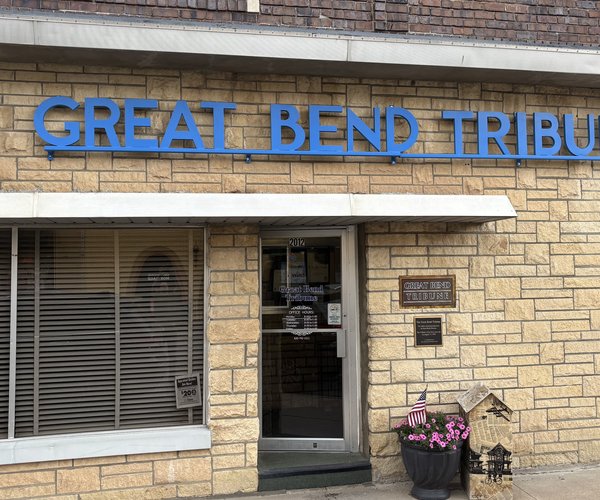
Here’s an invitation to our readers: stop by the Tribune office on Thursdays from 9-11 a.m. for a cup of coffee and conversation.
Andrew Murphy has multiple roles at the Great Bend Tribune, including special assignment reporter. Contact him at amurphy@gbtribune.com.