As a boy growing up in Great Bend, Kelley Hrabe would sometimes ride his 10-speed bicycle through the gardens of the Dominican Motherhouse on his way to Kwik Shop near Broadway Avenue and McKinley Street. Occasionally, he would find himself being chased by the very sisters whose historic home he is now hoping to save.
“I used to live on Meadowlark and would ride my bike through the gardens back in the ’80s,” he recalled with a laugh. “Got chased by a few nuns back in the day. I don’t think I was supposed to be biking through there.”
More than four decades later, Hrabe is returning to familiar ground with a much bigger purpose — preserving one of Great Bend’s most recognizable landmarks and giving it a new life serving the community.
But turning that vision into reality will require more than his experience as a developer. It will take the support of the community he still considers home.
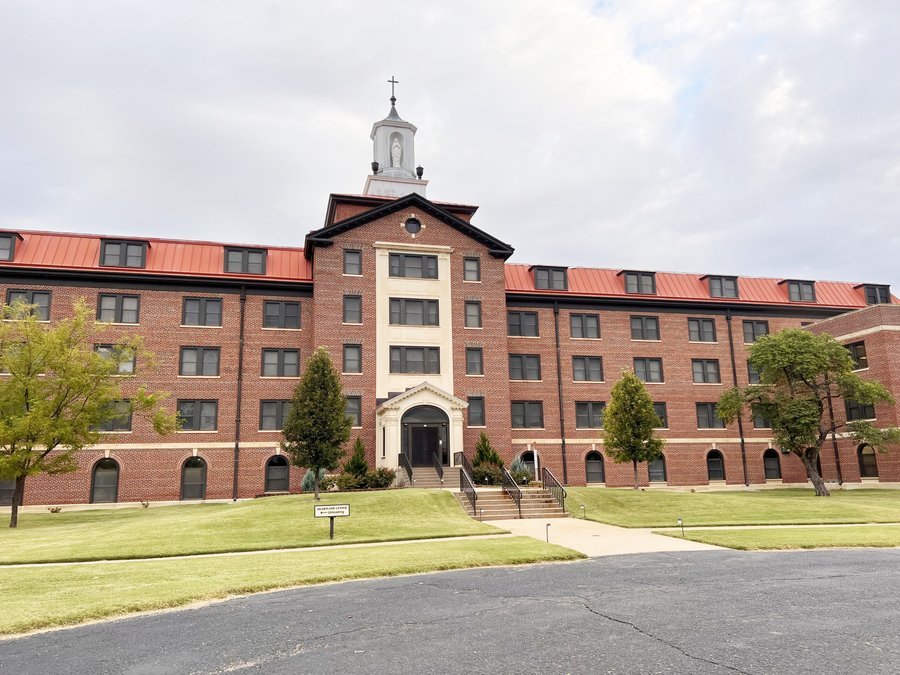
Hrabe, a 1986 Great Bend High School graduate and founder and managing partner of Riverstone Platform Partners, is leading a proposed $24 million redevelopment of the Dominican Motherhouse at 3600 Broadway Ave. The project, known as Cornerstone Commons, would transform the five-story building into 50 to 60 affordable apartments for adults 55 and older while preserving its historic character and creating space for community organizations.
For Hrabe, the project represents an opportunity to bring his professional experience back to the place where he grew up.
He attended Jefferson Elementary School and Harrison Junior High School before graduating from Great Bend High School. Although his mother has since moved to Lawrence, he still has friends in Great Bend, many of whom he saw during a recent class reunion.
“I’ve always wanted to do a deal and a project in my hometown,” he said.
The opportunity presented itself when Hrabe saw a Great Bend Tribune story on Facebook about the Dominican Sisters of Peace preparing to close the Motherhouse by the end of 2026.
“I saw something about it winding down with its current use,” he said. “Kind of sparked my interest because this is exactly the kind of projects we get involved with.”
He began making inquiries about the property’s future, eventually connecting with longtime friend Curt Mauler, owner of L&M Construction, whom he has known since junior high school. The two worked together on bridge crews during college.
Hrabe also met with Great Bend Economic Development and community stakeholders who had been exploring potential uses for the property.
“They were very supportive,” he said. “On these projects I like to go in and meet with the cities and communities first. If there’s a lot of opposition to what we’re proposing, we respectfully move on. No point in causing trouble.”
With encouragement from local stakeholders, Riverstone contacted the Dominican Sisters of Peace in Ohio and began pursuing a purchase agreement.
The goal, Hrabe said, is to complete an adaptive reuse project that respects the building’s past while making it financially sustainable for future generations.
“Hopefully moving this forward to do adaptive reuse and make it a great asset for the community,” he said.
A personal connection to the Sisters
For more than eight decades, the Motherhouse has stood as a landmark rooted in faith, service and caring for others. Its cornerstone was laid in 1940, and generations of area residents have developed personal connections to the Dominican Sisters and their work.
Hrabe is among them.
His grandfather received cancer treatment at the Sisters’ hospital in the early 1970s, a connection he rediscovered while researching the property’s history and talking with his mother.
“I remember being at the hospital before my grandpa passed away and just the connection of the old hospital to the Dominican Sisters,” he said. “I didn’t really realize the impact and what they had done for the hospital.”
Although Riverstone was already interested in the project, learning more about his family’s history with the Sisters made the undertaking even more meaningful.
“Being a hometown guy from Great Bend, it’s kind of a nice tie-in and makes this project that much more important to me,” he said.
Historic preservation is also a significant part of Riverstone’s work. Hrabe said approximately one-third of the company’s projects involve preserving historic properties, often by converting buildings that have outlived their original purposes into housing.
The Motherhouse, he believes, is particularly well suited for that approach.
“These properties don’t lend themselves well to big families,” he said.
In rural communities, affordable senior apartments can also help address a broader housing shortage by providing options for older homeowners who no longer want to maintain large houses.
“Particularly in the rural markets, say there’s an elderly person who has a big house and they don’t want to maintain anymore,” Hrabe said. “They would like to sell it but they don’t really have any place to go. They need somewhere that’s affordable and moderately priced.”
By creating that option, he said, seniors can remain in their communities while making existing homes available to younger families.
“They can sell their house to maybe a younger family and kind of help with that cycle of housing development in the community,” he said.
Affordable housing with a purpose
Cornerstone Commons would offer apartments ranging from studios to two-bedroom units, with preliminary monthly rents estimated between $450 and $1,250. Final rents would depend on financing and other factors.
The apartments would serve households earning approximately 30% to 80% of the area’s median income, with eligibility determined by income requirements associated with affordable housing tax credits.
Hrabe said Riverstone conducted a preliminary market analysis to determine whether Great Bend could support a development of this size.
The results were encouraging.
For a project of approximately 50 to 60 units, the estimated market capture rate is 2.7%, meaning the apartments would need to attract only a small percentage of the eligible senior housing market.
“Anything under 10% is a really good market, so that says there’s a good market for this type of product in Great Bend,” he said. “There hasn’t been a whole lot built of this scale for seniors in this market.”
The apartments would be designed with aging residents in mind, incorporating elevators, accessible entrances and units that could accommodate changing mobility needs. Additional apartments would be specifically designed for residents with disabilities.
Hrabe said the building already has features that lend themselves to senior housing, including interior railings and common spaces.
The development would provide independent living rather than assisted living, although partnerships with local organizations could eventually expand the services available to residents.
“We’re housing developers, and you can’t turn on the radio or read a newspaper and not see the need for affordable housing today,” he said.
Preserving the past
Despite the extensive renovation required to convert the Motherhouse into apartments, Hrabe intends to preserve much of what makes the building special.
“Definitely all the public spaces,” he said. “We’re placing it on the historic register, so definitely the corridors, chapel, public areas. Outside will look the same.”
Exterior improvements could include landscaping, lighting, parking areas, curbs and gutters, but the historic appearance of the building would largely remain unchanged.
Inside, the former residential rooms would need to be combined to create larger apartments, while significant public spaces would be preserved.
Among the features Hrabe hopes to retain are the Chapel of the Plains, the auditorium, historic corridors, smaller libraries and the main entrance.
“The chapel, obviously — the auditorium, which I can really see the auditorium being used for community uses,” he said.
Because the building has served a religious purpose, some religious items would need to be removed as part of the process of decommissioning it. Hrabe said that would be done while maintaining the chapel’s architectural integrity.
The vision extends well beyond providing apartments.
Under a concept Riverstone calls “Hub Below, Homes Above,” the ground floor could become a gathering place for nonprofit organizations, senior services and other community uses.
Existing amenities, including libraries, laundry facilities and a dining room, create opportunities to make the building more than a residential complex.
“Hopefully we can really not just lock it down for the people living there, but open parts to the community while making sure it’s secure for tenants,” Hrabe said.
He believes there are ways to separate public gathering spaces from private residential areas, allowing the Motherhouse to remain a community resource.
Another possibility is creating a resilience hub, equipped with generators, that could provide shelter during severe weather or power outages.
“If there’s an ice storm or tornado or something, it gives not only tenants but people in the neighborhood a place to go,” he said.
Riverstone is also exploring geothermal heating and cooling and other energy-efficient systems to keep utility costs manageable.
The broader campus could eventually accommodate additional housing, including townhomes or other age-restricted apartments, although those possibilities remain in the early planning stages.
A $24 million challenge
While the plans offer an opportunity to preserve the Motherhouse, Hrabe emphasizes that the project is far from guaranteed.
“The main financing is through historic tax credits and housing tax credits,” Hrabe said. “It’s a very competitive process.”
Together, those credits represent approximately 60% of the project’s financing.
Without them, the redevelopment cannot move forward under the current plan.
“We wouldn’t be pursuing this if we didn’t think we could secure the funding, but it takes city, political and community support,” Hrabe said.
The preliminary application is due in January, followed by a full application in May. Riverstone hopes to receive a financing decision next summer, potentially allowing it to purchase the property and begin renovation work in approximately a year.
But the purchase agreement is tied to that financing.
If the necessary tax credits are not awarded in 2027, Hrabe said, the purchase contract would expire.
“We have some challenges, so it’s not a done deal,” he said. “If we all partner together, there’s a high probability of getting funding.”
That makes the coming months especially important.
Riverstone is seeking letters of support from residents, community organizations, elected officials, state legislators and others who believe the historic building should be preserved.
The company is also encouraging residents to share photographs, stories and personal memories of the Motherhouse and the Dominican Sisters.
All of that, Hrabe believes, can help demonstrate to state officials why the project deserves funding.
“There are a lot of projects across the state, but this is something special,” he said. “If you look at the history and what the mission here has been and the impact it’s had, not only in Great Bend but the surrounding areas, I think it will show well to the state.”
Riverstone is also pursuing local financing tools, including industrial revenue bonds and a Rural Housing Incentive District, which could provide tax-related incentives to help cover development costs.
Hrabe is scheduled to meet with Great Bend city officials Nov. 2 to discuss potential assistance.
He said the proposed financing mechanisms are commonly used in housing developments and would help offset the unusually high cost of rehabilitating an older structure.
The property is not currently on the tax rolls, but redevelopment could return it to taxable use, with some future tax revenue potentially reinvested in the project.
Riverstone is also discussing potential financial support with the Golden Belt Community Foundation and exploring other funding opportunities.
Community support could make the difference
Hrabe believes preserving the building is important not only because of its architectural and historical significance, but also because of what could happen if it remains vacant.
“The alternative on properties like this is when they’re vacant, they start to deteriorate quickly,” he said. “Last thing anyone wants. Then it becomes a liability and more expensive to renovate.”
Although the Motherhouse presents technical challenges, particularly with its mechanical systems, he said the property appears to have been well maintained.
“It’s a major one,” he said of the heating and cooling systems. “It looks like whoever maintained it has kept it in great condition. We’re hoping to reuse that.”
The building’s condition gives Riverstone an encouraging starting point.
“We’ve done a lot worse buildings than this,” he said. “We’re starting off on a good foot here.”
And while the long-term benefits would include affordable housing and historic preservation, Hrabe sees the renovation itself as an economic development opportunity.
Riverstone intends to give qualified local subcontractors, suppliers and vendors opportunities to participate in the construction process.
“If we’re going to invest $24 million in a community, how can we leverage that to help local companies and vendors?” he said.
For Hrabe, who once pedaled his bicycle through the Motherhouse gardens, the chance to preserve the building and bring that investment to his hometown is an opportunity he doesn’t take lightly.
But he knows his company cannot accomplish it alone.
The Sisters spent decades serving Great Bend and surrounding communities. Now, as their time in the historic building comes to an end, its future may depend on how strongly the community rallies behind the effort to give it another purpose.
“The more letters of support we can get, the better,” Hrabe said.
And with state funding decisions ahead, he hopes Great Bend will make its voice heard.
“It’s going to be a full-court press making sure the state knows that this is a priority,” he said.
For a building whose cornerstone was laid in 1940, Cornerstone Commons could represent a new chapter — one that preserves its place in Great Bend’s history while carrying forward the Dominican Sisters’ longstanding mission of service.